

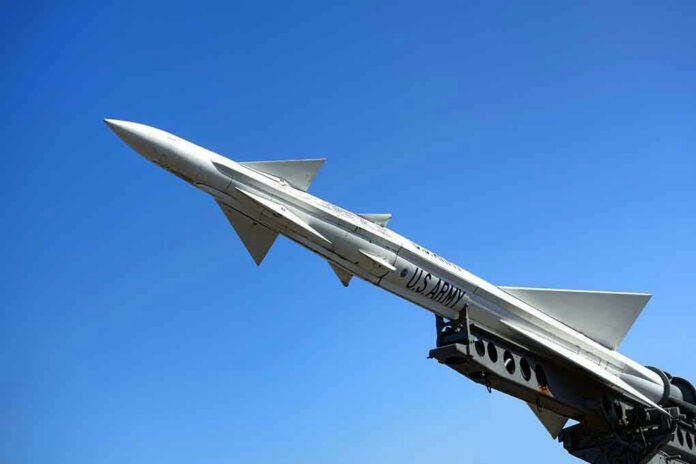
America’s first Army hypersonic battery is edging from test range to war footing, but unanswered questions about inventory, cost, and combat data could decide whether Dark Eagle deters enemies—or drains resources.
Story Highlights
- Army reports fielding Dark Eagle to a multidomain task force in December 2025, signaling initial operational capability [1][3]
- December 2024 end-to-end flight test marked a milestone after delays and launcher fixes [3]
- Leidos awarded a $2.7 billion production contract in 2026 to accelerate combat deployment [5]
- Pentagon-linked commentary and analysts cite mixed 2024 results and thin combat-effectiveness data through 2027 [6]
Army Fielding Signals Readiness, But Deployment Decisions Remain Pending
Fox News reported that the United States Army began fielding the long-range hypersonic system to a multidomain task force in December 2025 after years of delays, with officials framing this as the step toward operational use [1]. Wikipedia’s program history aligns on timing and notes the Army’s hope to field after resolving launcher issues, culminating in a successful December 2024 end-to-end test [3]. However, public reporting indicates no finalized combat deployment approval to the Middle East, despite interest tied to threats from Iran [1].
For conservative readers focused on peace through strength, the signal is clear: the Army has moved Dark Eagle from concept to units, a hard-won milestone after years of Beltway churn. Still, deterring adversaries requires more than ceremony. Officials have yet to announce a combat theater deployment, reflecting standard prudence and the need to align logistics, security, and policy with the system’s real-world readiness. That operational caution matters when adversaries probe for gaps and propaganda opportunities [1][3].
Testing Milestones Meet Skeptic Warnings About Data Gaps and Costs
Program backers point to the December 12, 2024 end-to-end flight at Cape Canaveral as a turning point, the first complete demonstration bridging launcher, booster, glide body, and test objectives after launcher fixes [3]. Yet skeptical coverage has highlighted 2024’s uneven results, discussed thin publicly available performance data, and questioned whether the Pentagon can certify true combat effectiveness before 2027—a caution that tempers the triumphal headlines and urges disciplined pacing over political timelines [6].
Cost scrutiny also shadows the march to deployment. Commentary has cited wide unit-cost estimates and asked whether using a top-shelf hypersonic against non-existential threats is wise, especially if inventory is initially constrained [6]. That critique resonates with conservatives who watched Washington’s blank checks fuel overruns for two decades. The remedy is transparency: clear criteria for combat suitability, honest reporting on test outcomes, and firm guardrails that keep production and sustainment on budget without compromising capability [6].
Production Push: $2.7 Billion Contract Aims To Convert Prototypes Into Arsenal
Army Recognition reported a $2.7 billion award to Leidos to drive the Common Hypersonic Glide Body and associated elements from testing into production, a move intended to stabilize quality, scale output, and position batteries for combat deployment under the Trump administration’s defense posture [5]. The contract underscores seriousness of purpose: after fielding a unit, the next test is whether industry can deliver repeatable performance at pace while resolving the kind of production niggles that historically delayed advanced missiles [5].
U.S. Army Dark Eagle Hypersonic Missile Moves Toward Combat Deployment Under $2.7B Leidos Contract pic.twitter.com/RJnc0VHcUi
— Army Recognition (@ArmyRecognition) May 13, 2026
Fiscal conservatives should demand measurable benchmarks from this contract: throughput, defect rates, and reliability growth tied to incentives and penalties. If Leidos and partners hit those marks, the Pentagon gets a credible deterrent that compresses enemy decision time. If they miss, the program repeats the cycle of overruns and schedule slips. Public analysis warning that earlier test data are incomplete only heightens the need for disciplined, results-based contract oversight to protect taxpayers and warfighters alike [5][6].
What Combat Credibility Requires Now: Verification, Inventory, and Doctrine
Commanders need more than a ribbon-cutting to deter Iran or any other adversary. First, they need verified reliability across weather, countermeasures, and contested communications. Second, they need enough rounds to matter, replenishment plans, and secure basing that avoids a “one-and-done” spectacle. Third, they need doctrine that integrates hypersonic strikes with cyber, space, and traditional fires so each shot changes the calculus at theater scale. Fielding plus production momentum is promising; proof under realistic conditions makes it real [1][3][5][6].
Conservatives can back the core objective—overmatch against those who chant “death to America”—while insisting on guardrails that past administrations ignored. That means no politically driven deployment photo-ops, no budget bloat disguised as “urgency,” and no secrecy that hides shortcomings from congressional oversight. If the Army sustains test success, expands inventory responsibly, and meets contract targets, Dark Eagle can be the quiet deterrent that preserves peace without endless wars or wasteful spending [1][3][5][6].
Sources:
[1] Web – Dark Eagle hypersonic weapon Middle East deployment … – Fox News
[3] Web – Long-Range Hypersonic Weapon – Wikipedia
[5] Web – U.S. Army Dark Eagle Hypersonic Missile Moves Toward Combat …
[6] YouTube – U.S. Mulls Dark Eagle Deployment: Can It Target Iran’s …