
President Trump’s order to blockade the Strait of Hormuz signals Washington is ready to use hard power to stop Iran from turning a global shipping chokepoint into a cash register.
Quick Take
- Trump announced the U.S. Navy will block “any and all” ships attempting to enter or leave the Strait of Hormuz after U.S.-Iran talks in Pakistan ended without agreement.
- The directive includes interdicting vessels in international waters that have paid tolls to Iran and beginning operations to destroy mines the U.S. says Iran laid in the strait.
- The strait carries roughly one-third of the world’s seaborne oil, making the move a high-stakes test for energy prices, maritime insurance, and U.S. deterrence.
- Officials have not publicly detailed which allies will participate, how long enforcement will last, or the precise legal framework for stopping third-country ships.
What Trump Ordered, and Why It Matters Immediately
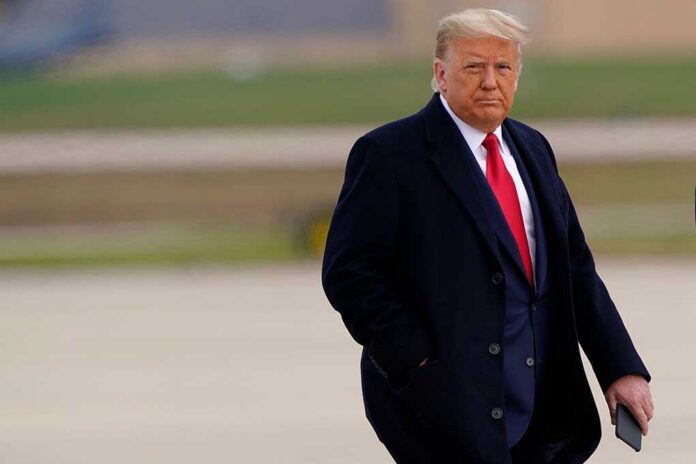
President Donald Trump said Sunday that the U.S. Navy will begin a naval blockade of the Strait of Hormuz “effective immediately,” following face-to-face negotiations led by Vice President JD Vance in Islamabad. Trump framed Iran’s reported toll collection on transiting ships as “illegal extortion” and directed U.S. forces to stop traffic in and out of the waterway. The administration’s stated goal is to strip Tehran of leverage and restore free passage.
NO DEAL: President Trump tells Maria Bartiromo that the U.S. will begin blocking ships in the Strait of Hormuz after Iran refused to give up its nuclear ambitions during lengthy negotiations. | @SundayFutures @MariaBartiromo pic.twitter.com/MLEikS8qr9
— Fox News (@FoxNews) April 12, 2026
Trump’s post also instructed the Navy to “seek and interdict every vessel in International Waters that has paid a toll to Iran,” widening the action beyond Iranian-flagged shipping. He added that the U.S. will begin destroying mines the Iranians allegedly placed in the strait and issued a warning of overwhelming retaliation if Iranian forces fire on U.S. assets or commercial vessels. Public reporting has not clarified where mines are located or how quickly clearance can proceed.
The Strait of Hormuz: A Chokepoint With Global Energy Consequences
The Strait of Hormuz is one of the most strategically important waterways on Earth, with reporting noting that about one-third of the world’s seaborne oil moves through it. That reality is why even short disruptions can ripple into gasoline prices, home-heating costs, and broader inflation pressures—issues that already weigh heavily on U.S. households. Trump’s blockade announcement effectively turns a regional standoff into an international economic event.
From a conservative perspective, the policy rationale is straightforward: freedom of navigation is a core U.S. interest, and allowing a hostile regime to impose de facto tolls would normalize a shakedown model that undermines global trade. At the same time, blocking “any and all” ships is a blunt tool that could raise costs for American consumers if energy markets tighten. The available reporting does not yet quantify expected supply impacts or likely duration.
Diplomacy Collapses, Deterrence Takes Over
The blockade follows peace talks that ended without a deal, despite Trump saying “most points were agreed to” while “the only point that really mattered, NUCLEAR,” was not resolved. That contradiction—talks described as going well, paired with an immediate escalation—suggests the nuclear file was the decisive sticking point. Vance’s message was that Iran declined U.S. terms, and Trump moved quickly to military pressure rather than a prolonged negotiating loop.
This shift matters politically at home because it lands in a climate where many Americans, right and left, believe Washington too often fails to enforce its own red lines. Conservatives who felt prior administrations projected weakness toward adversaries will see a clearer display of leverage. Critics, including many on the left, are likely to argue the move risks regional war and economic blowback. The strongest verifiable point in current reporting is the sequence: failed talks, then blockade order.
Operational Risks: Mines, Missiles, Fast Boats, and Drones
Former National Security Adviser John Bolton described the military challenge as far more complex than simply sweeping mines. He pointed to the need to protect tanker convoys against anti-ship missiles, swarms of Iranian fast boats, and drones that can drop weapons, drawing on past U.S.-Iran maritime encounters. Those threats highlight why a blockade—especially one involving third-country ships—can raise the risk of miscalculation, even if U.S. forces maintain dominance.
Key uncertainties remain. Reporting indicates Trump said other countries will participate, but no public list of partners or rules of engagement has been detailed. It is also unclear how the U.S. will determine which vessels “paid a toll,” how interdictions will be handled legally, and what off-ramps exist if Iran de-escalates. Until those specifics are released, the practical scope of enforcement and the risk profile for commercial shippers will be difficult to assess.
For Americans watching from home, the immediate test is whether the administration can protect free passage without triggering a prolonged price spike or a broader shooting conflict. The longer-term test is institutional: whether Washington can pair credible deterrence with durable diplomacy that prevents repeated crises. For a public exhausted by elite failures—on spending, borders, and energy—this episode will be judged less by rhetoric and more by results that show up in security and everyday costs.
Sources:
Trump says U.S. will begin blocking ships in Strait of Hormuz after Iran peace talks fail
Trump announces naval blockade of Iran’s Strait of Hormuz after peace talks fail