

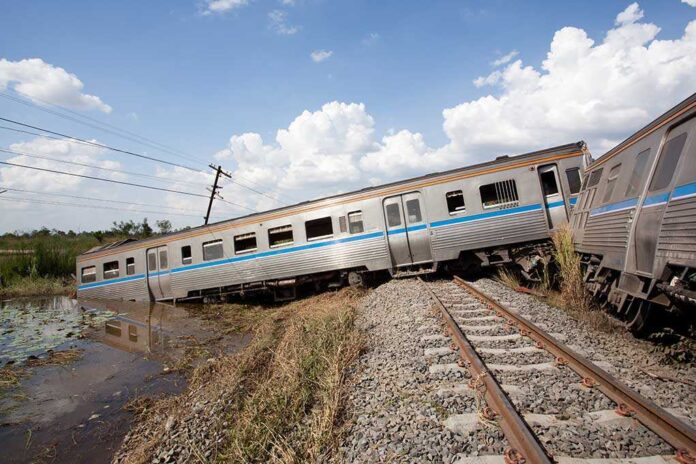
A deadly crane collapse onto a moving passenger train in Thailand exposes the catastrophic safety failures plaguing China’s Belt and Road Initiative projects, killing at least 32 people and raising serious questions about foreign contractor accountability.
Story Highlights
- Construction crane collapsed onto passenger train during Chinese-backed railway project, killing 32 and injuring 66
- Italian-Thai Development contractor has pattern of deadly safety failures including 100 deaths in previous building collapse
- $16.8 billion high-speed railway connects China to Southeast Asia under Beijing’s Belt and Road Initiative
- Thai government threatens contractor blacklisting as Prime Minister admits laws need reform to expedite accountability
Foreign Infrastructure Project Claims Dozens of Lives
On January 14, 2026, a construction crane lifting concrete slabs for China’s ambitious railway expansion project collapsed onto a moving passenger train in Nakhon Ratchasima province, Thailand. The disaster occurred at 9:05 AM local time as the train traveled between stations, carrying approximately 195 passengers bound for Ubon Ratchathani province. The crane was part of the Bangkok-Nong Khai high-speed railway network, a cornerstone project of China’s Belt and Road Initiative valued at over $16.8 billion.
The second passenger cabin bore the brunt of the impact, with victims either burned beyond recognition or crushed by debris. Most casualties were students and employees commuting to neighboring districts. Rescue operations continued for hours as workers searched unstable wreckage for survivors, highlighting the devastating scope of this preventable tragedy.
Troubled Contractor’s Pattern of Deadly Negligence
Italian-Thai Development, the primary contractor responsible for the crane operation, carries a disturbing history of construction disasters. In March 2025, the company co-led construction of Bangkok’s State Audit Building, which collapsed during an earthquake, killing approximately 100 people. Earlier incidents include a railway tunnel collapse in August 2024 that claimed three workers’ lives and multiple fatal accidents on Bangkok expressway extensions under ITD oversight.
This pattern of safety failures demonstrates systemic negligence that extends far beyond isolated incidents. The crane operator, Sombat Simthantuk, reported hearing sounds resembling structural failure before the collapse, suggesting inadequate equipment inspection protocols. Such warning signs should have triggered immediate safety shutdowns, yet construction continued with deadly consequences for innocent passengers.
Government Response Exposes Regulatory Weakness
Thai officials scrambled to address contractor accountability following the disaster. Transport Minister Piphat Ratchakitprakan ordered investigations while Acting Railway Governor Anan Phonimdaeng announced legal action against Italian-Thai Development. The company faces over $3.2 million in train damage costs plus compensation obligations to victims’ families, though monetary settlements cannot restore lost lives.
Prime Minister Anutin Charnvirakul’s admission that existing laws prevent rapid contractor blacklisting reveals dangerous regulatory gaps. His acknowledgment that legal reforms are needed exposes how foreign contractors operate with insufficient oversight, endangering Thai citizens while pursuing profitable infrastructure contracts. This regulatory weakness enables repeated safety violations without meaningful consequences.
China’s Belt and Road Initiative Under Scrutiny
The disaster raises fundamental questions about China’s infrastructure expansion strategy across Southeast Asia. Chinese Foreign Ministry Spokesperson Mao Ning’s response emphasized that construction was handled by “a Thai company,” attempting to distance Beijing from responsibility despite Chinese involvement in project design and supervision. This deflection highlights concerns about accountability when foreign powers finance major infrastructure while local contractors bear operational risks.
The high-speed railway project exemplifies how international partnerships can compromise safety standards when profit motives override public welfare. Thai taxpayers fund these massive projects expecting safe, reliable infrastructure, not deadly accidents caused by negligent contractors pursuing Chinese-backed development initiatives. The tragedy demonstrates why American infrastructure principles of rigorous safety oversight and contractor accountability remain superior to foreign alternatives.
Sources:
CBS News – Thailand derailment crane moving passenger train many dead
Wikipedia – 2026 Sikhio train disaster