

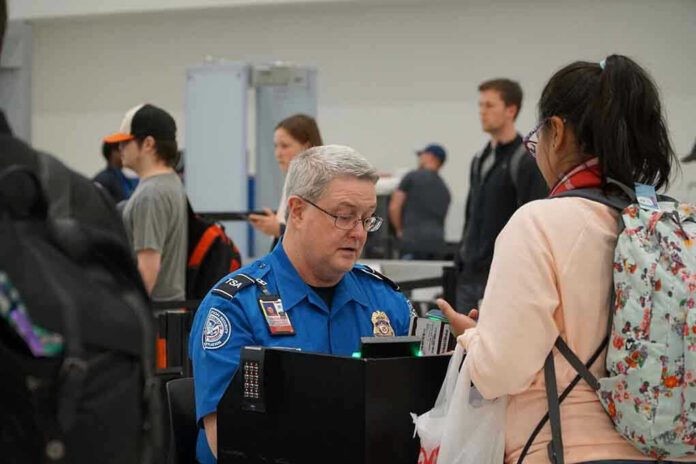
Trump’s threat to put ICE agents in America’s airports exposes how a Washington funding fight can quickly spill into everyday life for millions of law-abiding travelers.
Quick Take
- President Trump said ICE agents could be sent to airports starting March 23 unless Democrats approve DHS funding without limits on ICE operations.
- A partial shutdown that began Feb. 14 left TSA operating without funding during spring break, fueling long lines, call-outs, and hundreds of resignations.
- Reports say ICE agents are not trained for TSA-style checkpoint screening, raising practical questions about what “help” would look like on the ground.
- Democrats are tying DHS funding to ICE accountability demands, while Republicans say TSA won’t be funded separately from immigration enforcement policy.
Trump’s Airport ICE Warning Tied Directly to the DHS Funding Standoff
President Donald Trump said Saturday, March 21, that he would deploy Immigration and Customs Enforcement agents to U.S. airports beginning Monday, March 23, if Democrats refuse to pass Department of Homeland Security funding without restrictions on ICE operations. The White House framed the possible move as a response to growing airport disruptions. The warning lands in the middle of a shutdown-fueled operational mess that is now hitting ordinary travelers during peak spring break traffic.
Trump’s statement did not arrive in a vacuum. The shutdown started Feb. 14 and has pinched DHS components differently, but TSA has become the most visible pressure point because it directly affects public travel. With TSA personnel working without pay, absences and resignations have climbed, and long lines have been reported at major hubs. DHS and TSA leadership have also warned that some smaller airports could face temporary closures if staffing drops further.
TSA Staffing Losses Are Real, but the “ICE Fix” Raises Operational Questions
Reports across outlets put TSA’s attrition since the shutdown at roughly the high hundreds, with figures varying as new departures are tallied. The pattern described is consistent: unpaid “essential” employees keep screening travelers, then financial stress drives more resignations and call-outs, which worsens delays and piles more stress onto remaining staff. Some local officials have stepped in with stopgap help such as meal support and transit assistance, underscoring how severe the pinch has become.
At the same time, the proposed solution has an obvious limitation: multiple reports state ICE agents are not trained for airport security operations. TSA checkpoint work relies on specialized screening procedures, threat detection routines, and passenger-flow management that are distinct from immigration enforcement. Without clear details on how ICE would be used, the public is left with unanswered questions: would ICE do administrative support, perimeter functions, or immigration enforcement activity near checkpoints while TSA handles screening?
Democrats Demand ICE Constraints; Republicans Reject Splitting TSA from Immigration Policy
The funding fight is not simply about paychecks; it is about policy control. Democrats have withheld DHS funding while demanding stronger ICE oversight and accountability measures following fatal shootings involving ICE agents in Minneapolis earlier in 2026, including the deaths of Alex Pretti and Renee Good, according to reports. The White House offered limited changes in mid-March, including body cameras, restrictions tied to sensitive locations, and more visible identification, but rejected other demands.
Democratic leaders have also pressed for additional requirements related to warrants and limits on masked operations, and they have publicly criticized the ICE-to-airports idea. Republicans, for their part, have taken the position that Congress should not fund TSA separately from broader DHS and immigration enforcement policy, effectively linking the traveler-facing crisis to the larger debate. Multiple funding votes have failed, indicating the standoff remains entrenched and politically costly for both sides.
Rhetoric About Targeted Enforcement Raises Civil-Liberty and Political Stakes
Trump’s comments included pointed references to Minnesota and Somali immigrants, and the reporting describes the rhetoric as emphasizing arrests of “illegal immigrants,” with a particular focus on Somali nationals. That framing matters because airports are shared public spaces where Americans expect consistent, neutral screening rules. When immigration enforcement language is introduced into the airport experience, the risk of confusion and perceived unequal treatment rises, even if the intent is deterrence and law enforcement visibility.
Sen. Patty Murray argued the plan could create wrongful detentions and harassment rather than smoother travel, while Republicans highlighted the need to enforce immigration law and restore order. The public record in these reports does not provide details on operational guardrails, complaint processes, or how traveler rights would be protected if ICE personnel were placed into airport workflows. Until specifics are released, both constitutional concerns and security practicalities will remain central to the debate.
What Happens Next: A Shutdown Pressure Cooker with No Clear Off-Ramp
The immediate question is whether the threat becomes an actual deployment, or whether it functions primarily as leverage to force a DHS funding deal. TSA’s situation keeps intensifying because the shutdown’s impacts compound over time: more resignations mean fewer trained screeners, which can drive longer lines and more call-outs. As spring break crowds continue, political leaders face mounting pressure to end the standoff in a way that restores normal operations without creating a new, improvised security structure.
For conservative voters, the larger takeaway is straightforward: when Congress turns basic agency funding into a proxy war over immigration policy, the public pays first—standing in longer lines, missing flights, and watching Washington argue over reforms that never seem to arrive. The reporting also makes one point hard to ignore: if ICE is truly being considered for airport roles, the administration and Congress owe the public clear, written boundaries explaining authority, training, and how lawful travelers are protected.
Sources:
Trump Threatens to Deploy ICE Agents to Airports Over DHS Funding Impasse
Trump threatens to put ICE agents in airports over funding fight
ICE officers soon will help with airport security unless Democrats end shutdown, Trump says