
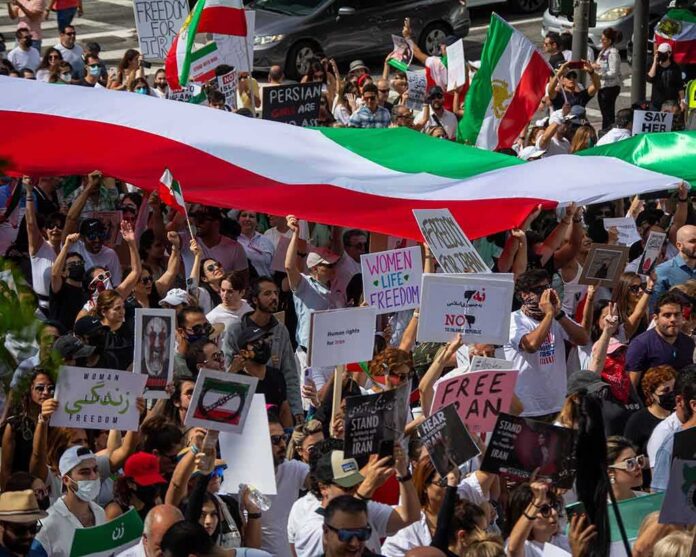
Iranian demonstrators in Tehran celebrated U.S. midterm results as a win for Iran, burning American and Israeli flags and mocking U.S. leaders, even as Iranian officials sent mixed messages about what the vote means.
Story Snapshot
- State-organized Tehran rally hailed Democratic gains as a blow to President Trump’s approach to Iran.
- Iran’s parliament speaker claimed Americans voted “no to war,” warning of consequences if ignored.
- Iran’s supreme leader signaled no real change in U.S. hostility regardless of party control.
- Reports tie the U.S. result to voter worries about war risks and higher prices, not a clear Iran-policy shift.
Tehran Rally Casts U.S. Vote as an Iranian Win
Associated Press reported that demonstrators in Tehran marked the midterm outcome as a setback for President Trump and the Republican Party. At a government-organized event tied to the 1979 U.S. Embassy takeover anniversary, crowds burned American and Israeli flags and displayed effigies of Trump and Israel’s Benjamin Netanyahu. USA Today video described protesters calling Democratic gains a “victory” for Iran, reinforcing the regime’s message in real time to both local and global audiences.
Organizers framed the elections as proof that Americans fear a wider war and rising costs. The Associated Press linked the vote to public concern over war-related fuel and consumer prices, which Iranian actors portrayed as backlash to Trump’s hard line. This narrative fit long-standing regime themes: present U.S. political shifts as validation while keeping pressure on Washington. The images from the rally amplified that point, even if the event itself was structured by the state and not a spontaneous protest.
Iranian Leadership Sends Mixed Signals
Iranian Parliament Speaker Mohammad Bagher Ghalibaf posted that “Americans said NO TO WAR,” adding that the United States would face consequences if its government ignored voters’ views. That statement cast the midterms as a clear message on conflict. Yet statements attributed to Supreme Leader Mojtaba Khamenei countered any idea that a partisan swing would soften Washington’s stance, warning that U.S. hostility would continue regardless of who leads Congress.
These split messages served a tactical goal at home and abroad. Officials highlighted an American rebuke of war, while hedging against any expectation of relief. That allowed Tehran to claim a narrative win without promising policy gains. As of now, reports do not document a direct U.S. policy change after the vote. No new sanctions relief, military pullback, or legislative shift tied to Iran has been established in the immediate aftermath.
What The Celebration Does—and Does Not—Show
The rally offered a vivid signal, not a clear measure of Iranian public opinion. The Associated Press identified the Tehran gathering as a government-organized demonstration, which limits what it can prove about views across Iran. The coverage did not provide crowd-size estimates or surveys that could show broader support. It showed how quickly leaders and state media can turn a foreign election into a message to their own people and to American voters watching from afar.
For Americans across the spectrum, the takeaway is sobering. A foreign government took a U.S. domestic vote and spun it to its advantage. Many citizens already feel Washington is not listening on war, budgets, and prices. Seeing Tehran claim the midterms as proof only deepens that concern. The result may pressure U.S. leaders—Republican and Democrat—to explain goals, costs, and the path to stability. Clear, honest communication is the only way to deny adversaries the last word.
Sources:
bbc.com, apnews.com, cbsnews.com, heraldonline.com, iranintl.com
© truetrendnews.com 2026. All rights reserved.