

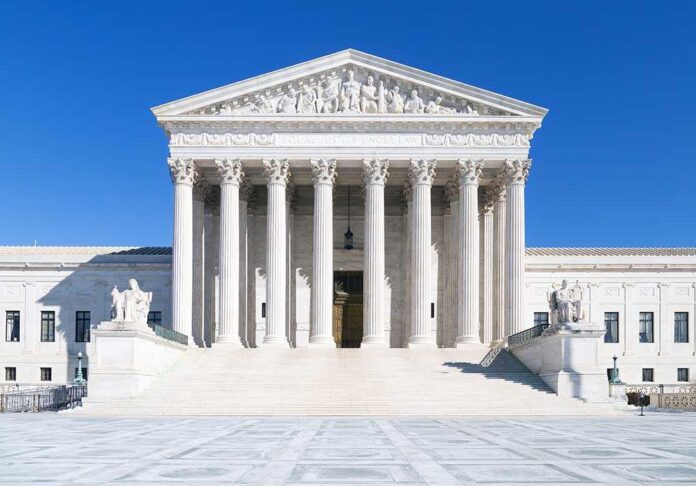
The Supreme Court just handed Texas—and President Trump—a major redistricting win, and the left is already melting down on cable news.
Story Highlights
- The Supreme Court cleared Texas to use its new 2025 congressional map for the 2026 midterms, reversing a lower court that tried to block it as an “illegal racial gerrymander.”
- The map is designed to give Republicans control of roughly 30 of 38 House seats from Texas, strengthening Trump’s hand in a razor-thin Congress.
- Progressive activists and MSNBC-style commentators are framing the ruling as the “end of the Voting Rights Act,” while conservative legal voices call it a win for state sovereignty.
- The fight exposes a bigger national battle over whether left-wing lawfare can use racial gerrymandering claims to override ordinary partisan map‑drawing.
Supreme Court Sides With Texas Map
The core of this story is simple but huge: the Supreme Court issued an emergency order letting Texas use its 2025 congressional map in the 2026 midterm elections after a three‑judge federal district court tried to shut it down as an unconstitutional racial gerrymander. That lower court wanted Texas forced back onto its 2021 map, but the justices stepped in and put that ruling on hold. For conservatives, this means elections will proceed under a map drawn by elected lawmakers, not unelected judges.
The legal timeline shows how aggressively progressive litigators moved to stop the Texas Legislature and Governor Greg Abbott from locking in gains for Republicans. In summer 2025, Texas passed and Abbott signed a new map aimed at expanding GOP seats after President Trump urged a redraw to bolster Republican strength in the U.S. House. By fall, voting‑rights groups sued, claiming racial gerrymandering and dilution of Black and Latino voting power, and in November a district court tried to freeze the new map before candidates could even file.
How Progressive Lawsuits Collided With Election Reality
The Supreme Court’s intervention came under intense time pressure, with candidate filing deadlines looming and campaigns needing to know which districts actually exist. First, Justice Samuel Alito, overseeing emergency matters from the region, issued a temporary stay of the lower court’s injunction so the justices could review full briefing. Days later, the Court granted Texas a more durable stay that effectively reinstated the 2025 map for 2026, even as the underlying lawsuit continues. That practical timing makes the ruling outcome‑determinative for at least one full election cycle.
What makes this case particularly explosive is who wrote the initial lower‑court opinion and how the Supreme Court handled it. The 160‑page ruling finding likely racial gerrymandering came from District Judge Jeffrey Brown, himself a Trump appointee, yet a Supreme Court majority still overruled his injunction. A Reagan‑appointed 5th Circuit judge had already dissented below, arguing the evidence did not justify such sweeping relief, and conservatives now cite that view as support for letting Texas’s elected branches, not trial courts, set the political map heading into a pivotal midterm season.
Racial Gerrymandering Claims Versus Partisan Line‑Drawing
The heart of the legal clash is where partisan advantage ends and racial gerrymandering begins, a line that has grown fuzzier since the Court’s earlier Rucho decision. Texas officials openly admit the 2025 map is engineered to maximize Republican seats, but they insist that is a lawful partisan motive, not an illegal racial one. Plaintiffs counter that demographic patterns and district shapes show race played the dominant role, pointing to claims that white voters control about 70 percent of districts despite being a smaller share of the statewide population.
For conservatives concerned about endless lawfare, the Texas case looks like another effort to weaponize race to override any map that benefits Republicans. Progressive activists argue that communities of color are being “packed” and “cracked” to weaken their influence, yet they also push national strategies that seek to guarantee more Democratic‑leaning seats under the banner of civil rights. The Supreme Court’s stay signals that, unless plaintiffs can clearly prove race predominated over politics, federal courts will be reluctant to rip up maps in the middle of an election calendar.
Why This Is a Strategic Win for Trump and the GOP
Practically, the stakes for 2026 are enormous. The new Texas map is designed to give Republicans around 30 of the state’s 38 House seats, up from roughly 25 under the 2021 configuration, in a Congress where just a handful of districts often decide control. Several Democratic incumbents now find themselves drawn into tougher or overlapping districts, setting up bruising member‑versus‑member primaries or retirements, while new GOP‑leaning districts invite fresh conservative candidates to step forward. That shift strengthens President Trump’s leverage to advance his agenda in Washington.
Nationally, the order sends a clear message to other Republican‑led states watching from the sidelines. Legislatures considering mid‑decade remaps now see that if they move decisively and defend their plans as partisan rather than racial, they are more likely to withstand emergency challenges. At the same time, the Court’s reluctance to approve late‑breaking changes close to filing deadlines encourages states to plan around the calendar, knowing that judges are increasingly wary of injecting chaos into active election cycles.
https://twitter.com/TownhallUpdates/status/1996935110105424025
For conservative readers frustrated with years of judicial activism and “woke” legal theories, this ruling offers both relief and a warning. It is a relief because the justices refused to let a contested discrimination narrative override a legislature’s constitutional authority to draw districts. It is a warning because the broader lawsuit is far from over, and future decisions on the merits could still reshape how much room red states have to fight back against left‑wing attempts to nationalize election rules through the courts. Vigilance on redistricting battles will remain essential.
Sources:
Texas Supreme Court redistricting coverage – Texas Tribune
Federal court blocks Texas’s 2025 redistricting map – Lawyers’ Committee
Redistricting Litigation Roundup – Brennan Center for Justice
Texas redistricting and Supreme Court gerrymander coverage – MS Now legal blog
Texas redistricting lawsuit latest coverage – MS Now