

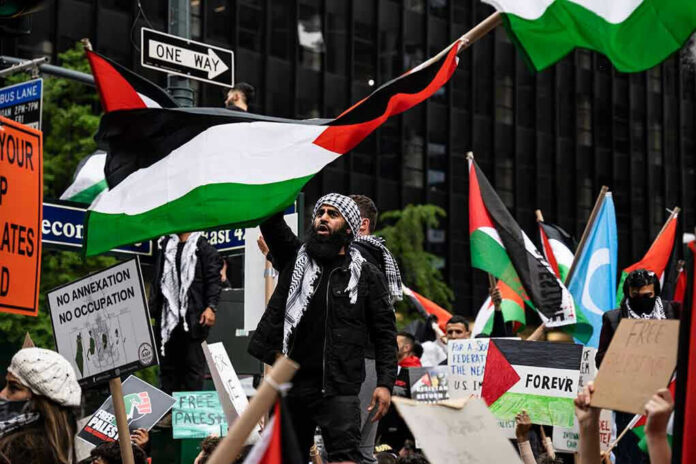
In a controversial move, the recognition of Palestinian statehood by the UK, Canada, and Australia has sparked international debate, with Hamas publicly celebrating what they see as a victory for their cause.
Story Highlights
- Hamas praises recognition by Western countries as a reward for its anti-Israel stance.
- The decision signals a shift in Western diplomatic policy traditionally aligned with Israel.
- Israel condemns the move, recalling ambassadors and warning of diplomatic fallout.
- Recognition may set a precedent, impacting future peace negotiations and international relations.
Hamas’s Reaction to Statehood Recognition
The recent recognition of Palestinian statehood by the United Kingdom, Canada, and Australia has been met with enthusiasm by Hamas, a designated terrorist organization. On September 21, 2025, Hamas issued a statement applauding the decision, describing it as an “important step” and a reward for their ongoing resistance against Israel. This development occurs in the context of ongoing tensions following the October 2023 attacks initiated by Hamas on Israel, which led to a prolonged conflict.
Hamas, which controls the Gaza Strip, interprets this recognition as a boost to its legitimacy and a victory for its strategy of resistance. The statement by Hamas highlights the complex interplay between international diplomacy and non-state actors, raising concerns about the implications for peace and security in the region. The move by these Western countries, historically aligned with Israel, marks a significant shift in diplomatic policy.
Diplomatic and International Reactions
The announcement has led to a strong response from Israel, which condemned the decision and recalled its ambassadors from the recognizing countries. Israel argues that this unilateral recognition undermines the peace process and rewards terrorism, thus setting a dangerous precedent. The decision has also sparked mixed reactions globally, with some countries praising the move as a step towards a two-state solution while others express concern that it could embolden extremist groups.
Domestically, the decision has led to protests and political debates in the UK, Canada, and Australia. These countries face internal pressures from diverse communities and geopolitical interests, influencing their foreign policy decisions. The recognition of Palestinian statehood has thus become a focal point for broader discussions on Middle East policy and international relations.
Implications for Peace and Regional Stability
In the short term, the recognition of Palestinian statehood by these Western democracies has strained diplomatic relations with Israel, potentially escalating regional tensions. The move also provides Hamas with political capital, which it may use to further its narrative of resistance. In the long term, this recognition could encourage other Western states to follow suit, influencing the landscape of international diplomacy.
Hamas Terrorists Rejoice as UK, Australia, and Canada Recognize Palestinian State. The weakass west rewards terror. But they forgot to ask the only one that matters. The USA. So FU Hamas. FU https://t.co/ZpSdCFmRQp
— catherder (@maligrandpa) September 22, 2025
This decision’s impact on the peace process remains uncertain. While it may pressure parties towards renewed negotiations, there is a risk that it could entrench divisions further. The balance of power between Hamas and the Palestinian Authority could also shift as a result of this recognition, affecting internal Palestinian politics and the broader dynamics of the Israeli-Palestinian conflict.
Sources:
Reuters, “Hamas welcomes recognition of Palestinian state by UK, Canada, Australia,” September 2025.
BBC News, “UK, Canada, Australia recognize Palestinian state,” September 2025.
The Guardian, “Diplomatic fallout after Western states recognize Palestine,” September 2025.
Times of Israel, “Israel condemns Western recognition of Palestinian state,” September 2025.