

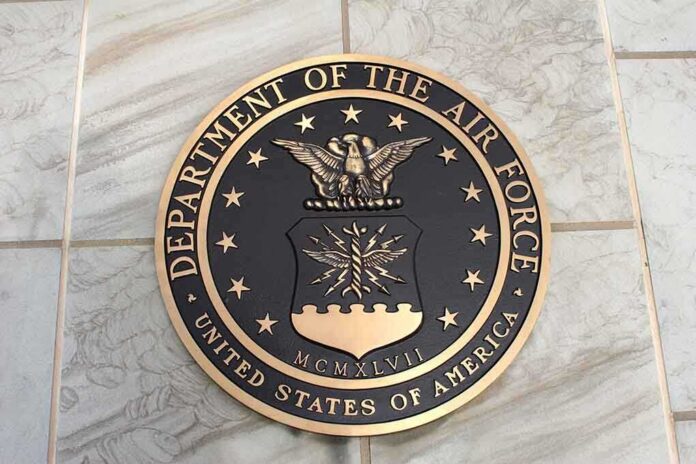
America’s top Air Force official just confirmed the United States has weapons operating in Earth’s orbit to defend U.S. forces.
Story Highlights
- Air Force Secretary Troy Meink said the U.S. has “on-orbit space control weapons.”
- U.S. Space Force issued a public statement confirming the deployed capability.
- Officials said space control can use kinetic and non-kinetic tools, for offense and defense.
- Details on systems, numbers, and launch dates were not disclosed.
What Officials Confirmed About Space Weapons
Air Force Secretary Troy Meink told a defense audience in Maryland on September 14, 2026, that the United States now has “on-orbit space control weapons” that can defend U.S. and allied forces from hostile actions. His statement marked the most direct public acknowledgment yet that the nation has active weapon systems in space. The United States Space Force backed this up with a public statement confirming those weapons exist to protect the Joint Force against threats in orbit.
The Space Force described space control as a mission that can use kinetic and non-kinetic means to affect an adversary’s space systems. Officials added these tools can support both offensive and defensive actions, depending on the mission. That wording signals a broad set of possible effects, from jamming and dazzling to physical disruption. It also reflects long-standing doctrine that treats space as a warfighting domain when U.S. assets face real risks from rival nations.
What We Still Do Not Know About the Systems
Officials did not say what the weapons are, how many are on orbit, or when they were launched. They also did not give a program name, a budget line, or a launch record. The disclosure came through Meink’s keynote remarks and a short Space Force statement, not a full congressional hearing or detailed memo. Those limits keep the focus on the policy shift—a public admission—without revealing the technical or operational picture.
Meink tied the announcement to “evolving threats,” which tracks with years of warnings about Chinese and Russian advances in counterspace. Senior leaders in recent years urged faster fielding of space-based capabilities to deter or blunt those moves. That push included calls for a cost-aware mix of ground and space systems to protect satellites that carry out navigation, communication, warning, and targeting missions for U.S. forces worldwide.
How This Fits Law, Doctrine, and Today’s Politics
The 1967 Outer Space Treaty bans nuclear and other weapons of mass destruction in orbit, but it does not bar all military tools. U.S. doctrine has long defined counterspace as both offensive and defensive. That mismatch between legal limits and broad doctrine often fuels headline tension. Many people hear “weapons in space” and think only of banned arms, while militaries talk about electronic attack, cyber effects, or physical interceptors used to protect critical satellites.
🚨 US ADMITS IT HAS DEPLOYED WEAPONS IN SPACE
NATIONAL HARBOR, UNITED STATES – Meink’s decision to acknowledge space weapons without describing them creates a strategic ambiguity that forces rivals to guess at U.S. capabilities. That uncertainty can be useful because it… pic.twitter.com/3RWykZPK92
— The Content Factory (@tcf_updates) September 15, 2026
The disclosure also comes as the administration highlights missile defense concepts, including a so-called “Golden Dome” vision. Some reporting linked Meink’s remarks to space-based interceptor work and “flight ready” hardware. That can blur lines between counterspace weapons that target other satellites and missile defense layers that aim at threats launched from Earth. Today’s statements confirm an on-orbit space control capability, but they do not define its exact role across those missions.
Why This Matters for Everyday Americans
Everyday life depends on satellites for weather, timing, banking, shipping, and the internet backbone. U.S. troops also depend on space to see threats, talk across oceans, and guide precision weapons. Rivals know this and have built tools to jam, blind, hack, or even strike satellites. The government’s move signals it will not leave those systems undefended. Supporters call that common sense. Critics worry about an arms race. Both sides see a government that often reveals too little, too late.
What To Watch Next
Congress will likely press for closed-door updates on cost, command rules, and safeguards. Allies may ask how the capability fits joint operations and crisis control. Adversaries may test boundaries with more jamming or close approaches on orbit. Clearer policy on when and how the United States would use space control tools could steady nerves and guide escalation management. For now, the headline is simple: the United States says it has space weapons on orbit, and they are active today.
Sources:
washingtonpost.com, spacenews.com, nampa.org, armedservices.house.gov, aljazeera.com
© truetrendnews.com 2026. All rights reserved.