

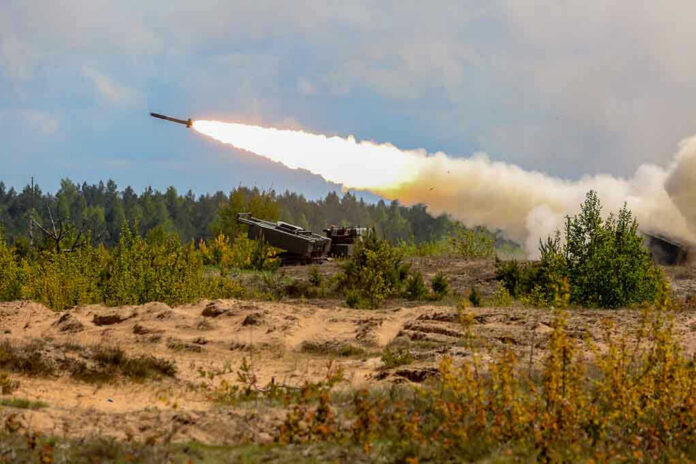
South Korea’s Chunmoo rocket launcher is quietly beating America’s HIMARS on raw firepower and flexibility, raising hard questions about how the West buys weapons and prepares for war.
Story Snapshot
- Chunmoo carries roughly double the rockets of HIMARS and can mix different rocket types in one vehicle.
- Its twin-pod, multi-caliber design lets crews tailor each mission, from massed “steel rain” to precision strikes.
- HIMARS still leads on combat record and deep missile inventory, but rivals like Chunmoo now win key export deals.
- These choices reflect wider worries that defense procurement serves elites and contractors more than front-line troops.
Chunmoo’s Twin-Pod Design Changes the Combat Math
South Korea’s K239 Chunmoo is a wheeled rocket launcher that carries two rocket pods on a single heavy truck, instead of HIMARS’ single pod on a lighter six-wheel vehicle. Each Chunmoo pod can be loaded with different types of rockets, and both pods can fire during the same mission, which means one truck rolls in with twice the ready-to-fire rounds and more options at the push of a button. For armies worried about running out of ammunition, that extra capacity is not a minor detail; it is the whole point.
Those pods are not just bigger; they are modular. Chunmoo can be loaded with up to 40 unguided 131-millimeter rockets for close-range area saturation, 12 medium rockets based on the older American 227-millimeter design, or 12 modern 239-millimeter guided rockets designed in South Korea. The launcher can carry two different pod types at once, so crews might load one pod with cheap short-range rounds for “steel rain” and the other with guided rockets for precision strikes against high-value targets. HIMARS, by contrast, only carries a single pod at a time.
Multi-Caliber Flexibility Versus HIMARS’ Focused Precision
South Korea’s army asked for Chunmoo to fire several rocket families, including its own 131-millimeter and 239-millimeter designs and standard 227-millimeter rockets used by Western systems. That request turned Chunmoo into a “Swiss Army knife” of rocket artillery. With one chassis, commanders can choose cheap bulk fire, mid-range battlefield rockets, or longer-range guided munitions. HIMARS focuses on fewer, high-end options, especially Guided Multiple Launch Rocket System (GMLRS) rockets and ballistic missiles like the Army Tactical Missile System and the new Precision Strike Missile.
HIMARS’ strength is not its pod count but its connection to a powerful missile ecosystem. The launcher can fire six precision GMLRS rockets, one Army Tactical Missile System missile, or two Precision Strike Missiles, reaching out to ranges around 300 kilometers for Army Tactical Missile System and over 400 kilometers for Precision Strike Missile, with combat-proven accuracy. Those missiles give the United States deep-strike options that Chunmoo is still developing, even as Chunmoo is reported to be working toward a 500-kilometer-class ballistic missile of its own. So Chunmoo’s edge is flexibility and volume, while HIMARS’ edge is long-range precision within a mature Western inventory.
Export Wins Show Growing Doubts About U.S. Dominance
European and NATO-aligned countries are now buying Chunmoo instead of HIMARS in some competitions, drawn by its twin-pod capacity and ability to use both Western and Korean rockets. Norway, for example, agreed to a multi-billion-dollar deal to field Chunmoo as its new rocket artillery system, choosing Hanwha Aerospace over American offerings. Analysts describe Chunmoo as a wheeled cousin of the older M270 launcher, delivering more ready-to-fire precision rockets per vehicle than HIMARS while still fitting Western logistics and doctrine.
These choices reflect a wider pattern in Western defense buying. Studies of arms procurement warn that governments often chase political and industrial goals—pleasing contractors, allies, and lobbyists—more than frontline needs. They find that foreign systems with better unit cost or faster delivery are often slowed or blocked by opaque rules and entrenched interests. When allies pick Chunmoo, they are not just buying a rocket truck; they are quietly voting against a system many citizens see as controlled by defense industry elites and distant bureaucrats instead of soldiers who have to fight with what they get.
What This Means for Ordinary Americans Watching Washington
The fight between Chunmoo and HIMARS may look like a niche hardware story, but it speaks to deeper fears shared by many conservatives and liberals. Older conservatives see another sign that “America First” talk does not always match results, as foreign systems beat U.S. gear on key features like magazine size and modularity. Older liberals see familiar patterns of military spending where huge sums go to big contractors while basic questions—can our troops get enough rockets, fast enough, at a fair price—go unanswered.
Both Chunmoo and HIMARS are capable rocket launchers; neither is “bad.” Chunmoo offers more rockets and more mix-and-match options per vehicle. HIMARS offers a proven track record and powerful long-range missiles with combat use in places like Iran. The real issue is how governments choose between them. When procurement is driven by politics and profit instead of clear battlefield needs, average citizens see one more example of a federal system that feels captured by a small group of insiders, even in something as simple as picking the best rocket truck.
Sources:
armyrecognition.com, en.wikipedia.org, youtube.com, m.hanwhaaerospace.com, facebook.com, army.mil, thedefensepost.com, twz.com, smallwarsjournal.com, lockheedmartin.com, europeanpapers.eu
© truetrendnews.com 2026. All rights reserved.