

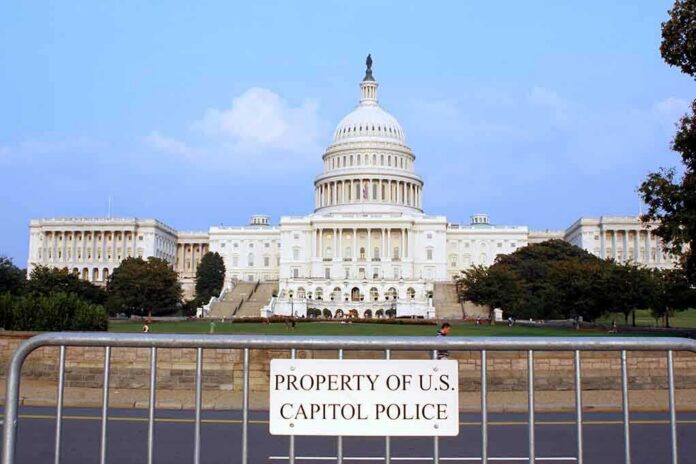
Congress just fired a warning shot at President Trump’s Iran strategy, but the fight over who controls war powers is far from over.
Story Snapshot
- Senate voted 50–48 for a war powers resolution telling Trump to halt military action in Iran.
- House passed a similar measure earlier this month, making this the first dual-chamber directive since 1973.
- The White House says the War Powers Act is unconstitutional and calls the resolution legally meaningless.
- The clash exposes deep tensions over the Constitution and who decides when Americans go to war.
Senate and House unite in rare war powers showdown
The United States Senate voted 50–48 to back a war powers resolution that directs President Donald Trump to stop United States military action against Iran, after the House of Representatives passed a similar measure earlier this month.[1] This is a rare case where both chambers have approved a resolution telling a president to remove United States armed forces from hostilities since the War Powers Resolution was enacted in 1973.[2] Four Republicans joined Democrats, signaling real unease about a conflict that started on February 28 and has become deeply unpopular.[1]
Under the War Powers Resolution of 1973, Congress claimed the power to order an end to hostilities through a concurrent resolution that does not require the president’s signature.[1][18] Supporters say this tool was designed after Vietnam to stop open-ended wars that were never clearly approved by voters or their representatives.[17] The current Iran measure follows that pattern, demanding that Trump withdraw forces from hostilities unless there is a declaration of war or specific authorization from Congress.[7]
White House rejects Congress’s move as “unconstitutional” and symbolic
The Trump White House is pushing back hard, arguing that the War Powers Act itself is unconstitutional and not binding on the president.[3] A White House official said the Senate vote has “no significance” because the concurrent resolution does not go to the president, has no force of law, and passed only because two Republicans were absent from the vote.[3] Officials also insist that hostilities ended with a ceasefire on April 7, claiming the resolution orders Trump to end a war that is already over.[3][5]
Legal analysts note that presidents from both parties have stretched their claimed constitutional powers under Article II for decades, often sending troops into danger without a formal declaration of war.[9][16] The executive branch argues the president can use force abroad when important national interests are at stake, as long as the operation does not rise to the level of a full “war” that needs advance congressional approval.[9] Critics respond that this view guts the Constitution’s clear language that only Congress can declare war and turns major conflicts into personal projects of whoever sits in the Oval Office.[20]
Symbolic rebuke or real check on endless wars?
Many mainstream outlets are already calling the Iran war powers vote “largely symbolic,” stressing that the president can ignore it and that Congress lacks the votes to force his hand.[7][19] Even if lawmakers pass a binding joint resolution that reaches Trump’s desk, he can veto it, and there is nowhere near the two-thirds support in both chambers needed to override him.[19] This framing risks teaching Americans that their representatives are powerless on the most serious question in government: when the country goes to war.[4]
Here I’ll write what I think of GLUTTONOUS GENOCIDAL COCKROACH 🪳 NETANYAHU who’s greed supersedes all past generations of Murderers like #HITLER with US Presidents blessings in tow. They Create hateful wars and steal the Oil and Lands at the behest of PSYCHOPATH Netanyahu… pic.twitter.com/odb6lZ1DHX
— @PrincessBibiRF_ (@PrincessBibiRF2) June 20, 2026
At the same time, the vote exposes some cracks in the usual party line. Four Republicans in the House and four in the Senate joined Democrats in backing the resolution, breaking with years of routine support for broad presidential war powers.[19][6] Advocates say this shows growing concern about the cost of conflict, with one senator citing about $100 billion spent and dozens of American casualties as reasons to demand clear authorization.[19] For constitutional conservatives, the deeper issue is simple: wars must be debated, voted on, and owned by Congress, not carried out on autopilot from the White House.
What this fight means for conservative readers
For Trump supporters who value the Constitution, limited government, and strong national defense, this clash is complicated. On one hand, many back the president’s tough stance toward Iran and agree that preventing a nuclear weapon is a vital goal.[7] On the other hand, the same voters know that unchecked war powers feed the bloated deep state, explode spending, and send American service members into harm’s way without full, honest debate.[20] The War Powers Resolution was written to stop exactly that kind of open-ended, murky conflict.[18]
This Senate vote does not end the Iran war by itself, and the president is likely to press forward with his chosen strategy.[7] But it does put every lawmaker on record and reminds the country that Congress still has tools, including funding cuts and future binding resolutions, to assert its authority. For conservatives, the key is to demand both: a strong, decisive commander in chief, and a Congress that does its constitutional job instead of handing war decisions to bureaucrats or cable news talking heads.[21]
Sources:
[1] YouTube – US Senate votes to halt Iran war in latest rebuke of Trump
[2] Web – House passes resolution to end hostilities with Iran – NPR
[3] Web – The war powers resolution on the Iran war: What’s next? – PolitiFact
[4] YouTube – Senate Republicans vote down war powers resolution amid Iran …
[5] Web – US House passes Iran war powers resolution in rare pushback …
[6] Web – Roll Call Vote 119 th Congress – 2 nd Session – Senate.gov
[7] Web – House votes to block Trump from ordering more strikes on Iran
[9] Web – Iran War Powers resolution heads to the Senate | FOX 5 Atlanta
[16] Web – In rebuke of Trump, House passes war powers resolution aimed at …
[17] Web – War Powers Resolution Reporting Project – Reiss Center on Law …
[18] Web – Findings and Analysis | War Powers Resolution Reporting Project
[19] Web – What’s next for the War Powers Resolution on Iran? PolitiFact explains
[20] Web – War Powers | Brennan Center for Justice
[21] Web – [PDF] Ballotbox Diplomacy: The War Powers Resolution and the Use of …
© truetrendnews.com 2026. All rights reserved.