
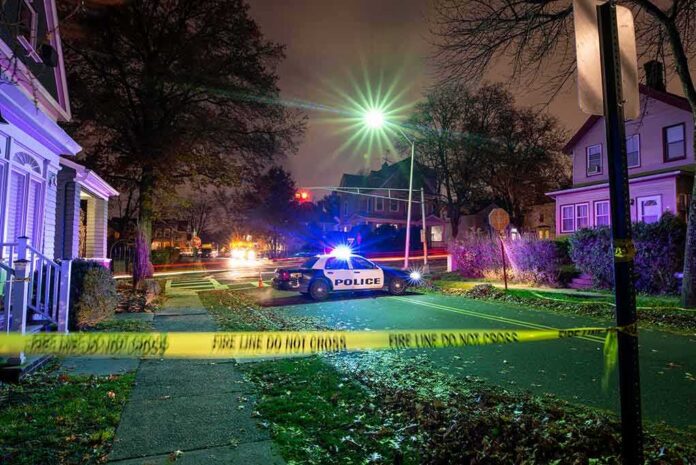
Charging documents say a 15-year-old escaped a basement after an unlicensed driver stabbed her and stole her phone in Baltimore.
Story Snapshot
- Court papers describe a kidnapping, stabbing, and basement escape using a fire extinguisher.
- Police arrested a suspect and a judge ordered him held without bond on multiple charges.
- Reports cite serious injuries, including multiple stab wounds and a collapsed lung.
- Name spellings vary across outlets, complicating records and searches.
What Police And Court Records Say Happened
On October 22, a teen accepted a ride in Baltimore. Charging documents say the driver went the wrong way, became violent, and took her to a home on Garrison Boulevard. There, he forced her to a basement and began stabbing her while removing her clothes, according to the girl’s statement to investigators. Police say they later arrested a suspect tied by vehicle details and a digital money transfer. A judge ordered him held without bond on attempted murder and related charges.
Reporters who reviewed court filings describe multiple stab wounds to the chest, ear, shoulder, back, and rib cage. One outlet reported a collapsed lung, which signals life‑threatening trauma. The documents also say the suspect took the girl’s phone. Investigators linked him through the car he drove and a Cash App transaction tied to the encounter, according to local reporting that summarized the charging records and police statements filed with the court.
How The Teen Fought Back And Escaped
During the struggle, the teen clawed at the attacker and looked for anything to use as a weapon. She found a fire extinguisher in the basement, struck him with it, and ran. That escape detail appears in community and local reporting that recounts the account provided to police. After fleeing, she reached help and received medical care for serious wounds. Police then moved to identify and arrest the suspect based on the described links and the recovered narrative from the victim interview.
Local outlets say the suspect faces attempted first‑degree murder, first‑ and second‑degree assault, kidnapping, and false imprisonment counts. Baltimore Police publicly announced the arrest, and court records list the charges and the no‑bond status, giving the case institutional weight beyond anonymous claims. Defense statements cited in court included that the defendant had no prior criminal history, but the judge still denied bond given the seriousness of the allegations and the described injuries to a minor.
Why This Case Strikes A Nerve On Safety And Oversight
This case highlights a risk that cuts across politics: unsafe rides from unlicensed drivers and informal pickups. City code makes providing taxi service without a license a misdemeanor offense with fines or short jail time, penalties far lighter than the harm that can follow when a ride turns predatory. That gap feeds a wider fear that basic systems meant to protect the public are not working as promised on the street level.
Courts have also documented crimes tied to transportation settings, including kidnappings by people posing as or working as drivers. Federal and state cases show both riders and drivers can be victims, proving the danger runs both ways. Those records do not make this Baltimore case typical, but they show the setting is a known target for bad actors who exploit trust, routine, and late‑night travel to isolate people and do harm.
What We Know, What We Do Not, And How To Respond
Reports are based on charging documents and police statements. That is strong early evidence, but it is still pretrial. The teen’s account anchors the narrative, and outlets did not identify independent witnesses inside the home. The suspect’s name appears with varied spellings across coverage, which can cause confusion when checking records. Despite those limits, the arrest, charges, and injury descriptions are consistent across several outlets that reviewed official filings.
Families can lower risk with a few steps. Meet rides at well‑lit, public spots. Confirm the plate and driver name before getting in. Share trip details live with a trusted contact. Avoid cash or off‑app payments that break the paper trail. City leaders can also help by enforcing licensing rules, improving public alerts about unlicensed pickups, and making it easier to verify a driver’s status in real time. These changes protect both riders and honest drivers.
The Bigger Picture: Trust And Basic Duties Of Government
People across the political spectrum want the same basics: safe streets, clear rules, and real follow‑through. When a teen can be lured into a basement from a routine ride, it shakes trust in those basics. Strong, even‑handed enforcement of licensing and violent‑crime laws is not a partisan idea. It is the floor of a functioning city. This case is now in the courts. The facts will be tested there. The duty to prevent the next attack belongs to all of us, starting now.
An unlicensed cab driver is charged with kidnapping a 15-year-old girl and forcing her into his basement apartment on Garrison Boulevard in Northwest Baltimore.
Police say he stabbed her at least 5 times, leaving her with a collapsed lung.
She fought back and hit him with a… pic.twitter.com/ojJESFcrCl
— Mike Hellgren (@HellgrenWJZ) October 26, 2026
Sources:
nypost.com, cbsnews.com, people.com, foxbaltimore.com, wbaltv.com, usmagazine.com
© truetrendnews.com 2026. All rights reserved.