

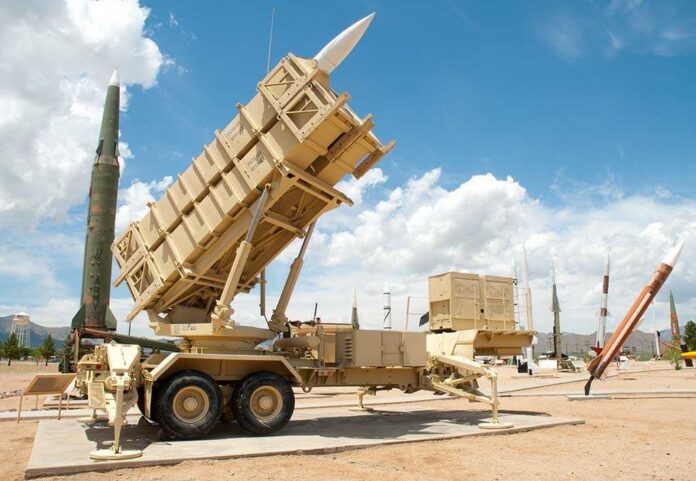
Analysts say U.S. Patriot interceptor stocks have dropped below 1,000, raising near-term air defense risk as rebuilding could take years.
Story Snapshot
- Analysts estimate Patriot interceptor stocks fell from about 2,300 to under 1,000.
- Sustained fights can drain finite Patriot and Terminal High Altitude Area Defense magazines fast.
- Test success does not always match wartime performance or large salvos.
- Refilling stockpiles will likely take years, affecting readiness and deterrence.
What Changed: Stocks Down After High-Tempo Defense
Analysts estimate U.S. Patriot interceptor stocks fell from roughly 2,300 to fewer than 1,000 after recent high-volume engagements tied to the Iran conflict. That drawdown reflects how fast modern air wars burn through interceptors. Each battery carries a limited load, and commanders often fire multiple missiles per target to raise kill odds. The result is a quick dip in inventory when salvos arrive night after night. These estimates point to a real, near-term readiness concern.
Terminal High Altitude Area Defense and Patriot are built to stop ballistic missiles in the terminal phase. But both systems have finite magazines and are meant to be part of a larger, layered defense. Government technical work on Terminal High Altitude Area Defense shows a single battery can defeat only a small barrage. Even with ideal one-for-one shots, one or two batteries provide limited coverage of key sites. Large salvos or sustained attacks can outpace reloads and logistics.
Why It Matters: Tests, Real Combat, And The Numbers
Public debate on missile defense swings between “it works” and “it breaks under pressure.” Past reviews highlight how counting rules and test design can inflate success rates. The Arms Control Association showed that changing how the “endgame” is defined shifted reported outcomes for earlier missile defense tests. That history reminds planners to be careful when mapping lab or range results to wartime chaos, decoys, and massed launches that strain intercept stocks.
Independent analysts also note that claimed single-shot kill odds do not settle the core issue in a saturation fight. If an attacker sends more missiles than a defender can engage, even high single-shot success rates will not protect every site. That is why inventory depth, production surge capacity, and reload speed often matter more than raw interceptor performance. In simple terms, you cannot shoot what you do not have on the launcher or in the magazine.
Rebuilding The Magazine: Time, Budget, And Industry Limits
Refilling interceptor stockpiles will likely take years, not months. Defense firms must source rocket motors, seekers, and propellants, which all face supply chain bottlenecks. Production lines can surge, but only to a point, and only with steady funding, long-lead orders, and labor. Large orders also compete with foreign sales and allied backlogs. This slow industrial ramp means U.S. forces could face a medium-term gap between ongoing demand and the pace of resupply.
The CSIS numbers are brutal and should alert every Western defense planner who hasn't been paying attention. Prewar stocks: 2330 Patriot interceptors and 452 THAAD. By July 27 those figures had collapsed to roughly 759-827 Patriots and 234-278 THAADs. That's the result of burning… pic.twitter.com/oce0jn2kIw
— medoyid_ua (@LetsArmUKR) July 30, 2026
Both conservatives and liberals share a core worry here. Taxpayers fund advanced defenses, yet key magazines run low when the country needs them most. Critics on the right blame years of global missions and poor stock planning. Critics on the left blame costly systems that still get saturated by mass salvos. Many see a deeper problem: Washington reacts to each crisis but does not build resilient supply lines, real surge capacity, or clear priorities to protect the homeland first.
Operational Tradeoffs: Layering, Tactics, And Cost
Commanders use layered defenses to save high-end rounds for the hardest threats. Lower-cost systems and electronic warfare can thin out drones and cruise missiles, leaving Patriot and Terminal High Altitude Area Defense for ballistic targets. But dense attacks force hard choices. Do you fire two interceptors at one target to improve odds, or hold one back for the next wave? Those decisions trade near-term protection against future risk when resupply is slow.
The math also matters. Attackers can mass inexpensive missiles and decoys to exhaust expensive interceptors. Past studies warn that results seen in controlled testing may not hold when salvos grow, clutter increases, and timing gets compressed. That gap between test range and battlefield drives the current alarm. It is not that the systems fail to work; it is that they can be outnumbered, which depletes stocks and opens windows of vulnerability until magazines are refilled.
Bottom Line: A Readiness Signal, Not A Panic
The reported drop in Patriot interceptors is a readiness signal that should focus leaders in both parties. The fix is not a slogan. It is steady orders, multi-year contracts, more workers, more testing that reflects real salvos, and honest tradeoffs on where to deploy scarce launchers. Until production catches up, the United States will need sharper layering, stricter shot discipline, and smarter logistics to stretch every missile while industry rebuilds the magazine.
Sources:
19fortyfive.com, eurasiareview.com, congress.gov
© truetrendnews.com 2026. All rights reserved.