
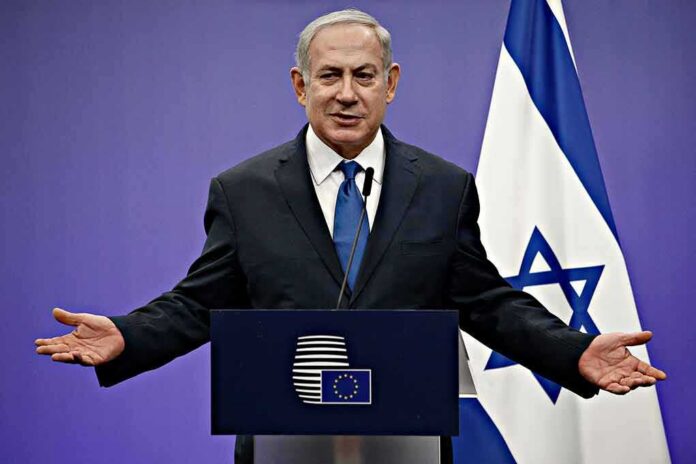
Israel’s Benjamin Netanyahu called the United Kingdom the “Islamic Republic of Britain,” tying the jab to a warning about Iran’s nuclear program, and set off a diplomatic firestorm.
Story Snapshot
- Netanyahu used the “Islamic Republic of Britain” phrase in a broadcast interview tied to an Iran nuclear warning.
- Reports say he contrasted past British support for Israel with today’s criticism and media climate.
- The United Kingdom government called the comments “completely unacceptable” and raised them with Israel.
- Critics in Britain called the remark Islamophobic and linked it to far-right rhetoric.
What Netanyahu Said And Why It Landed Hard
Israeli Prime Minister Benjamin Netanyahu said, “You might call Britain the ‘Islamic Republic of Britain,’” during an interview aired by Israeli Army Radio. He linked the phrase to a claim about the “first Islamic republic with nuclear weapons,” then said Israel was making sure there would not be another in Iran. Multiple outlets carried the same wording, which suggests accurate reproduction of his key lines. He aimed the comment at British politics and media attitudes as he shifted to the Iran threat.
Netanyahu framed the remark by recalling positive British coverage of Israel during the Six-Day War and contrasting it with what he sees in Britain today. Reports say he agreed when asked if parts of Europe had moved in the same direction. The rhetorical “Islamic Republic” label was not literal; the evidence does not show the United Kingdom is an Islamic republic. The line functioned as a cultural and political jab to support his bias claim and highlight his Iran message.
How London And Commentators Responded
The United Kingdom government called the comments “completely unacceptable” and said it raised the issue with Israel, signaling formal concern. Media coverage said the phrasing echoed far-right rhetoric and drew accusations of Islamophobia. Gavin Barwell, a former senior British official, labeled the remarks “blatant Islamophobia.” These reactions show how quickly the focus moved from Iran and media bias to the language used about Muslims in Britain.
The Irish Times said the comment played into a “common far-right Islamophobic trope” about Britain’s small Muslim population. Other outlets described the line as a pointed dig at a close ally and as a move that risks worsening already tense relations. In this cycle, charges of bias meet counter-charges of bigotry. The result is a shouting match that leaves little room for evidence on either media conduct or Iran’s nuclear progress.
What Is Firmly Known, And What Is Not
What is firm: Netanyahu made the remarks on the record, and several outlets matched the core quotes. The United Kingdom government objected on the record. The line about a nuclear “Islamic republic” was tied to Iran in the same segment. What is not firm: a full verbatim transcript or audio in the research package, which limits close review of tone, sequence, and any hedges he used. Translation choices could matter here.
The research does not show evidence that British policy matches the “Islamic republic” label. It also does not prove or disprove his claim of rising British media bias. Some studies and advocates argue British coverage has leaned toward Israel, but those are contested and come from interested groups. The core of this story stays the same: a charged phrase, a warning about Iran, and a backlash that centered on Islamophobia concerns, not nuclear policy.
Why This Matters For Readers In A Distrustful Era
This episode fits a wider pattern where sharp language drowns out substance. Leaders use hot phrases to steer attention, and rivals answer by condemning the tone. Ordinary people are left with noise while big issues, like Iran’s nuclear plans and the real state of media bias, go untested in public. Both the right and the left see the same thing: elites trading barbs while hard questions about security, immigration, faith, and free speech stay unresolved.
UK criticises Israel’s Netanyahu over ‘Islamic republic of Britain’ comment https://t.co/RaGTPkenGf
— The Straits Times (@straits_times) August 14, 2026
For citizens who feel the system favors insiders, this feels familiar. British officials defend national reputation. Israel’s leader rallies supporters by naming a threat. Media repeat the spiciest line. Meanwhile, none of this proves whether British outlets are fair to Israel or whether Iran is closer to a bomb. Clear answers would need data, transcripts, and independent checks. Until then, the safest ground is simple: quote what was said, show who objected, and separate rhetoric from fact.
Sources:
feedpress.me, aljazeera.com, ynetnews.com, jewishnews.co.uk, the-express.com, youtube.com, middleeasteye.net, fr.timesofisrael.com, bbc.com
© truetrendnews.com 2026. All rights reserved.