
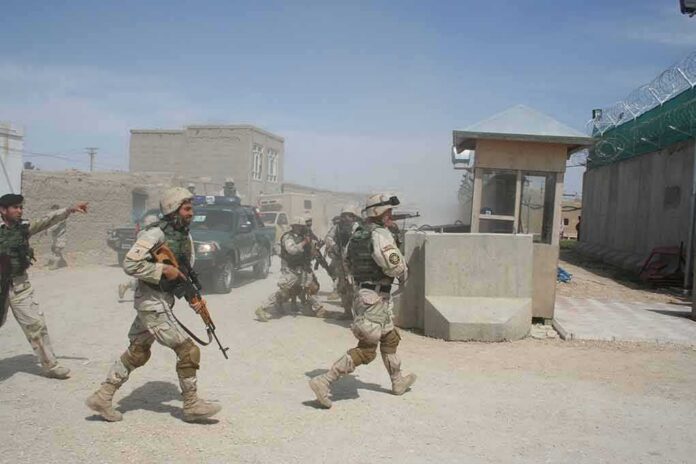
Armed robot dogs patrolled Haiti’s national stadium as Salvadoran and Haitian forces retook the site from gangs.
Story Highlights
- Haitian police, Haitian troops, and Salvadoran special forces secured Sylvio Cator Stadium in Port-au-Prince.
- Video released by El Salvador showed four-legged robots carrying rifles alongside Salvadoran troops.
- President Nayib Bukele linked the push to four missing Salvadoran technicians after an October 18 ambush.
- Bukele claimed forces destroyed a gang leader’s home and 400 Mawozo headquarters during the campaign.
Joint Operation Regains Control of Port-au-Prince Stadium
Haitian police, Haitian armed forces, a Haitian task force, and Salvadoran special forces moved into Sylvio Cator National Stadium in Port-au-Prince and took control after years of gang domination. President Nayib Bukele said the action was a joint mission under a bilateral agreement with Haiti. Associated Press video showed Salvadoran troops on the field and in the stands during the operation. Reports did not give a precise headcount for Salvadoran personnel at the stadium itself.
France 24 reported Haitian police retook the site with participation from Salvadoran units, underscoring that the stadium shift was not a solo foreign action. Bukele’s statement described a team effort across Haitian police, Haitian armed forces, a Haitian task force, and Salvadoran special forces under a bilateral framework. That framing matters because credit and responsibility tie back to who led, who followed, and how the two governments coordinated command and rules of engagement.
Robot Dogs With Rifles Draw Global Attention
Video released by El Salvador showed four-legged robotic platforms carrying rifles moving with Salvadoran troops during the stadium mission. Newsweek and Jamaica Observer both described the robots as “machine-gun-armed” or rifle-mounted, reflecting what the footage displayed. The reports did not show the robots firing weapons or confirm combat use, but their presence at a live operation marked a visible shift in the tools states use in urban security missions.
The robots’ appearance sparked focus on technology, not only on the gangs that held ground. That shift echoes a broader worry in the Americas: governments are scaling up force and tech to confront criminal groups while institutions struggle to keep up with oversight. People on the right and the left often see this as proof that leaders serve elites and security vendors before citizens’ safety and rights, even when public order is the stated goal.
Search for Missing Salvadoran Technicians Shaped the Push
Bukele linked the offensive to the disappearance of four Salvadoran aviation technicians after an October 18 ambush near Croix-des-Bouquets. GlobalPost said their armored vehicle came under attack during work connected to a United Nations–backed mission. Reports did not state that the stadium operation found or recovered the technicians, but the timeline and Bukele’s public message tied the rescue goal to the renewed push against gangs.
EL SALVADOR PRESIDENT NAYIB BUKELE HAS DEPLOYED ROBOT DOGS IN HAITI TO GO AFTER HAITIAN GANGS
This is a terrible precedent. This combination of AI & robotics can be used by governments against their own citizens and the AI won’t miss, unlike humans. https://t.co/spiOjmA4xd pic.twitter.com/7y8RtKcmBB
— Zach Jones – Psyops Czar (@ZachJones1994) November 16, 2026
France 24 reported that Bukele said Salvadoran forces destroyed the house of Wilson “Lanmò San Jou” Joseph, a leader of the 400 Mawozo gang, and the group’s headquarters. That claim added a victory note to the narrative of the stadium action. Independent confirmation of those specific demolitions was not presented in the cited reporting, but the claim fit the government’s broader aim to break gang strongholds and show forward momentum.
Why This Matters for Americans Watching From Afar
Haiti’s crisis has drawn outside forces many times, often with mixed results. Associated Press and Public Broadcasting Service timelines show that foreign missions can retake key sites yet struggle to fix deeper political and economic drivers of violence. Americans who fear rising crime, corruption, and waste at home can see a pattern here: strong tactical wins do not always deliver lasting safety when institutions are weak and accountability is unclear.
The Bigger Question: Order, Oversight, and Outcomes
Haitian and Salvadoran leaders presented the stadium as a clear step toward order. That matches what many citizens want: safe streets, honest policing, and swift action against armed groups. Still, past Haiti interventions show that mandate, command structure, and civilian oversight decide whether short wins become real change. Transparent reports on who led, what rules applied, and what force was used could turn this headline moment into a durable gain the public can trust.
Sources:
thegatewaypundit.com, apnews.com, jamaicaobserver.com, france24.com, wfiwradio.com, globalpost.com
© truetrendnews.com 2026. All rights reserved.