
A Rhode Island lawmaker’s vow of a “day of reckoning” for federal immigration officers has turned a local policy fight into a sharp warning sign about how far America’s political class is willing to go in its war over enforcement and civil liberties.
Story Snapshot
- Democratic State Representative Enrique Sanchez used violent language against Immigration and Customs Enforcement agents and promised a future “reckoning.”
- His comments came as Rhode Island Democrats pushed bills to curb immigration enforcement and block some former ICE officers from joining local police.
- Supporters say these measures protect immigrant communities from abuse, while critics say they endanger public safety and demonize law enforcement.
- The clash reflects a deeper national breakdown, where many Americans on the right and left feel both federal agencies and politicians serve elites, not ordinary citizens.
A Threat That Sounds Like More Than Just Rhetoric
Democratic State Representative Enrique Sanchez of Rhode Island posted that Immigration and Customs Enforcement (ICE) officers’ “day of reckoning will come motherf**kers, I swear to God,” in a message that shocked even hardened observers of the immigration debate. In a video response, he also called ICE officers “Nazi Gestapo thugs” and described their actions in Providence as “acts of terror” and “kidnappings,” tying his anger to recent enforcement operations against suspected gang members and other targets. His words did not stay in an online bubble; they quickly drew calls for censure and national criticism that painted his rhetoric as dangerous and extreme.
Sanchez framed his posts as a moral defense of immigrant families, saying that dealing with ICE “messed him up in the head” as he tried to protect “hundreds” of people from enforcement. He vowed to confront agents in person and said federal officers would “have to go through me first” if they continued their operations, moving his stance from protest to open resistance. For many Americans, this feels less like a policy argument and more like a sign that elected officials now treat federal agents as enemies, not public servants, even when those agents are pursuing suspects with serious criminal records.
The ‘ICE OUT Act’ and Rhode Island’s Push to Curb Enforcement
Sanchez’s outburst did not happen in a vacuum; Rhode Island Democrats have been advancing a slate of bills aimed at limiting ICE activity and local cooperation. One key proposal, known as the **ICE OUT Act**, would bar any law enforcement agency in the state from hiring someone who served as a sworn ICE officer on or after January 20, 2025, the start of President Trump’s second term. The measure, filed as House bill H7439 and Senate bill S2479, would take effect October 1, 2026 and applies only to future hires, but it sends a clear message that recent ICE experience is treated as a stain, not a qualification, for local policing.
At a March 4, 2026 hearing of the House Judiciary Committee, lawmakers and advocates weighed this hiring ban alongside other immigration bills in a five-hour session. The broader package backed by the Rhode Island Black, Latino, Indigenous, Asian-American and Pacific Islander Caucus would, among other steps, prohibit civil arrests at state courthouses without a judicial warrant and allow state residents to sue federal officers in state court if they violate constitutional rights. Supporters say these rules simply demand that federal agents follow the same basic legal standards as everyone else and that visible identification and warrant requirements prevent secretive tactics that frighten communities.
Organized Activism, Mounting Backlash, and Shared Distrust
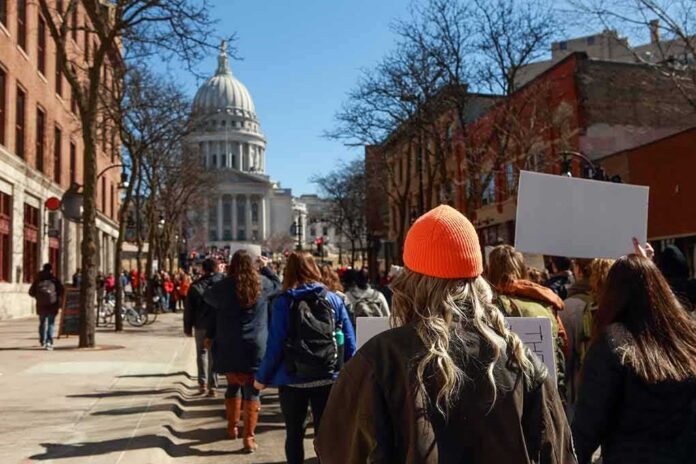
Grassroots groups have helped drive this anti-ICE momentum. Indivisible Rhode Island and allied organizations have rallied outside the offices of U.S. Senators Jack Reed and Sheldon Whitehouse, urging them to oppose funding for ICE and support efforts to rein in the agency’s powers. Rhode Island organizations and student groups are also preparing to join a national shutdown to call for abolishing ICE, signaling that local anger at federal enforcement is part of a wider campaign, not just one lawmaker’s social media outburst. These protests tap into real frustration among many Americans who see immigration raids, courthouse detentions, and masked officers as proof that federal agencies act with too little oversight and too little concern for ordinary people.
Critics, however, argue that Sanchez’s threats and the ICE OUT Act cross a line from protecting civil liberties into undermining basic public safety. They note that the operations he condemned included the arrest of a self-admitted MS-13 gang member tied to fentanyl trafficking, and they warn that blocking cooperation or demonizing agents makes it harder to stop dangerous criminals who prey on vulnerable communities. For conservatives already furious about crime, illegal immigration, and what they see as “woke” politicians siding with offenders over victims, Sanchez’s “day of reckoning” language confirms their fear that some elected officials hate enforcement more than they value safety.
What This Fight Reveals About America’s Deeper Crisis
This Rhode Island clash exposes a deeper reality that many people on both the right and left now share: they do not trust the federal government, its agencies, or its political class to put the public first. Supporters of ICE reform see officers who detain the wrong people, hide their identities, or operate with little accountability, and they blame a system that shields federal power from real checks. Opponents look at lawmakers calling agents “Nazi Gestapo thugs,” threatening “reckoning,” and trying to blacklist entire classes of officers from police jobs, and they see politicians more interested in grandstanding than in fixing broken laws or securing the border.
Rhode Island Democrat Enrique Sanchez Issues ‘Reckoning’ Threat to ICE, Gets an Earful in Return https://t.co/XIGbSztWxh
— A.C. Spollen (@ACSpollen) July 24, 2026
Both sides, in their own way, are reacting to a government that feels distant, unaccountable, and ruled by elites. When activists call for abolishing ICE and lawmakers push bills to wall off their state from federal enforcement, they are saying they do not believe Washington will ever police itself. When Republicans demand censure and highlight lawmaker threats as proof of “anti-law-enforcement extremism,” they are saying the political system has turned even basic safety into a culture war where ordinary citizens are the ones left exposed. The danger is that this spiral of distrust and outrage may leave the country with neither reliable enforcement nor real protection of rights—only deeper division and a sense that, once again, those in power are fighting each other while ordinary Americans bear the cost.
Sources:
dailywire.com, foxnews.com, bostonglobe.com, rhodeislandcurrent.com, fallriverreporter.com, yahoo.com, blackburn.senate.gov
© truetrendnews.com 2026. All rights reserved.