
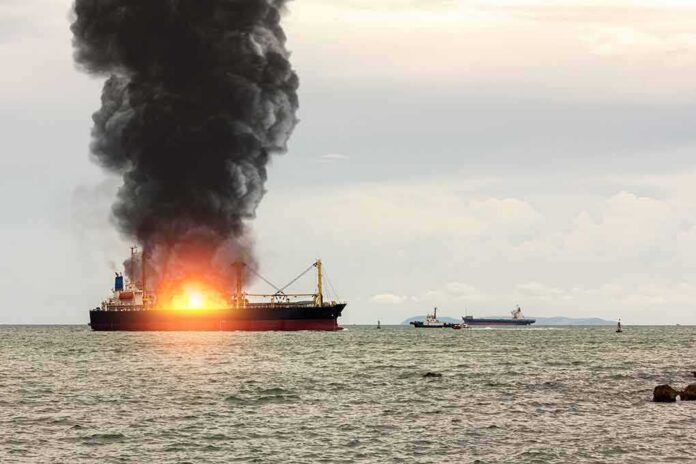
Fire roared across the Panama-flagged gas tanker Tara Gas in the Strait of Hormuz after a reported projectile strike forced its crew to abandon ship near Oman.
Story Highlights
- Maritime sources say a projectile hit the Tara Gas near Khasab, Oman, sparking fires.
- United Kingdom Maritime Trade Operations reported the vessel disabled about seven nautical miles north of Khasab.
- Omani authorities evacuated two dozen crew members from the burning ship.
- The strike comes amid a surge in tanker attacks that has lifted war-risk costs and fears for energy flows.
What Happened Near Khasab, Oman
Maritime security sources reported that the liquefied petroleum gas tanker Tara Gas was struck by a projectile while sailing through the Strait of Hormuz on November 17. The crew abandoned the vessel as fires spread on board, and the ship was left adrift near the Musandam Peninsula in Oman. The United Kingdom Maritime Trade Operations later logged the incident location about seven nautical miles north of Khasab and said the tanker was disabled with an engine-room fire.
Omani officials evacuated 24 crew members from the stricken ship as flames continued to burn. Local reporting tied the evacuation to a position roughly two nautical miles off the Musandam coast, underscoring how close the disabled tanker drifted to shore facilities. Images and video shared online showed a large plume and visible flames, consistent with an intense fire on a gas carrier. Authorities and industry monitors did not immediately assign responsibility for the strike in public statements.
Why The Strait Of Hormuz Is Always High Stakes
The Strait of Hormuz is a narrow sea lane that carries a major share of the world’s oil and gas. Past disruptions in this chokepoint have quickly hit global energy prices and supply chains, according to the Congressional Research Service. When a tanker carrying liquefied petroleum gas takes a hit, markets take notice. Even when fires are contained and crews are rescued, the risk of further attacks raises insurance costs, slows traffic, and pushes shippers to reroute or wait.
This latest strike lands during a period of unusually frequent attacks. Data cited by business outlets in October showed eleven tankers attacked in one week, a level not seen in years. More incidents raise the odds of missteps, higher premiums, and pauses at ports. For energy buyers, that often means higher prices and tighter supplies. For crews and coastal states, it means more rescue runs, more patrols, and more danger close to home.
What It Means For Energy, Trade, And Risk
Insurers and ship owners track alerts from the United Kingdom Maritime Trade Operations to set routes and set war-risk prices. Reports of a tanker disabled and burning near Khasab send a clear signal to operators: the risk is real and nearby. That can delay cargoes and add costs that filter down to consumers. For families already stretched by high living costs, another shock to fuel or heating prices would feel like one more failure of a system that should safeguard vital trade.
🇵🇦🇮🇷 An LPG tanker crew LEFT the ship after being hit by a projectile in the Strait of Hormuz and later caught fire 💀
The Panama-flagged Tara Gas was struck while sailing through the strait.
Oman rescued 24 crew members near the Musandam Peninsula.
India confirmed the…
— Mario Nawfal (@MarioNawfal) November 18, 2026
Both conservatives and liberals see a pattern here. A critical waterway is under strain, and ordinary people could pay the bill. The strike on Tara Gas shows how fast a single hit can threaten energy flows and worker safety. Americans expect their leaders to secure key trade routes, support allies who keep them open, and deter those who would endanger civilian ships. When that does not happen, trust in distant “experts” and global managers erodes even more.
How Governments And Shippers Can Respond Now
Officials can expand convoy protections, share real-time threat data, and speed emergency response teams. Clear rules of transit and firm messages to would-be attackers reduce ambiguity at sea. Shippers can harden vessels, adjust routes, and stage tugs and fire teams at chokepoints. These steps cost money, but they lower the chance that another gas carrier ends up burning near a busy coast. Each prevented strike is one less shock to crews, ports, and global markets.
Sources:
youtube.com, reuters.com, dailymaverick.co.za, gsmglobalnews.com
© truetrendnews.com 2026. All rights reserved.