

Scientists have now used artificial intelligence to design complete bacteriophage genomes that worked in the lab, and that marks a real leap in synthetic biology.
Quick Take
- Stanford University and the Arc Institute reported the first viable bacteriophage genomes created with generative AI.
- The team used Evo 1 and Evo 2 to design phages based on the ΦX174 bacteriophage template.
- Out of about 300 candidate genomes, 16 became functional viruses in laboratory tests with Escherichia coli.
- The result raises both medical hope and biosecurity concern because it shows design-to-function is now possible.
How the experiment worked
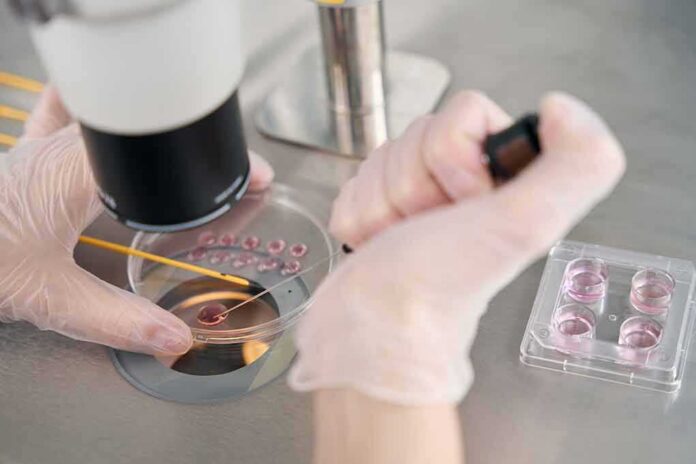
The researchers did not start with random viral code. They used genome language models, including Evo 1 and Evo 2, and fine-tuned them on bacteriophage data to generate new ΦX174-like genomes. Those designs were then synthesized and tested against laboratory strains of Escherichia coli. The public record says 16 of the AI-generated genomes booted up into viable phages, which makes this a working proof of concept rather than a simulation.
The scale matters as much as the result. One report says the team generated 302 candidate phages before finding the 16 that worked. Another source describes the process as a heavy funnel, where many proposed genomes failed before wet-lab validation. That kind of attrition is common in early synthetic biology. It also shows why the phrase “AI creates viruses” sounds broader than the actual experiment, which stayed inside a narrow, controlled test system.
Why the result matters
This study matters because it moves AI from prediction into biological construction. The preprint says the work is the first generative design of viable bacteriophage genomes, and other coverage says it is the first time whole viral genomes were successfully designed by AI. That does not mean the system can design any virus on demand. It does mean a model can write a genome that becomes a functioning virus after synthesis, assembly, and testing in cells.
The possible upside is clear. Bacteriophages are being studied as tools against antibiotic-resistant bacteria, and this work may help speed that search. Some reports say a few AI-designed phages matched or outperformed the natural template in lab tests, which suggests the method can do more than copy what already exists. For researchers trying to build better phage therapies, that is a major technical step forward.
Why the result also worries biosecurity experts
The same achievement also shows how much easier it may become to build useful biological agents from digital designs. The study stayed within ΦX174-like phages and Escherichia coli, so it did not show a human health threat or real-world misuse scenario. But it did show that AI can lower the barrier between a model-generated sequence and a working virus. That is why the work is drawing both excitement and caution in the same breath.
AI is entering biology.
Researchers at Stanford and the Arc Institute used genome language models to design complete viral genomes—and 16 of the AI-generated designs became functional bacteriophages that infected and killed E. coli in the lab.
This is an important threshold.… pic.twitter.com/zpAxjBEadE
— Farhad Nassiri Afshar, MD (@DrNassiriAfshar) August 7, 2026
That caution should stay grounded. The sources supplied here do not show an environmental release, a clinical use case, or proof of actual harm outside the lab. They also do not show that AI-designed phages are uniquely dangerous compared with older synthetic biology methods. What they do show is more concrete and more important: a computer system helped produce viral genomes that became real, functional phages after laboratory testing.
Sources:
insiderpaper.com, press.asimov.com, nature.com, eurekalert.org, biorxiv.org, letsdatascience.com, whataifound.org, biopharmatrend.com, scribd.com, cen.acs.org, theregister.com, facebook.com, youtube.com
© truetrendnews.com 2026. All rights reserved.