
The Pentagon is racing to buy hundreds of thousands of cheap, modular attack drones, betting mass “disposable” weapons can fix years of failure and bureaucracy in America’s war machine.
Story Snapshot
- The Defense Innovation Unit is seeking low-cost, ground-launched drones that can fly 50–300+ kilometers and swap payloads like smartphone apps.
- The Drone Dominance program plans more than 200,000 drones by early 2028, with $1.1 billion over 18 months and $54 billion tied to broader drone spending.
- Officials want modular, American-made systems to cut dependence on Chinese parts and speed production after seeing Iran, Russia, and Ukraine surge ahead.
- Key details remain vague, including unit cost and which companies will deliver long-range modular drones, fueling public doubts about Pentagon competence.
Pentagon’s new push for cheap, modular attack drones
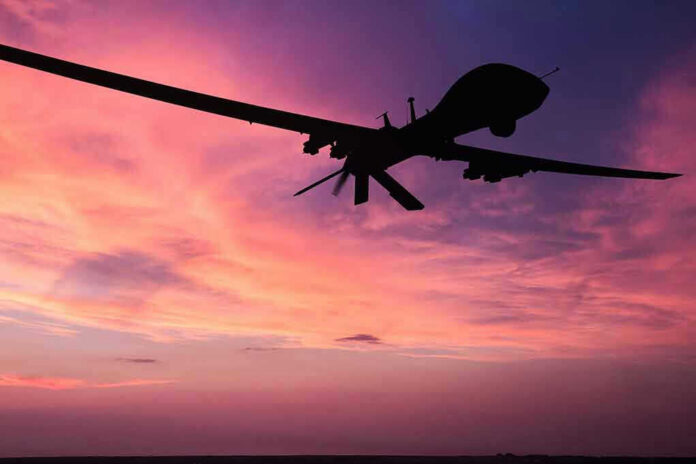
The Defense Innovation Unit, a Pentagon office meant to tap commercial tech, has issued a formal call for **low-cost, one-way unmanned aerial systems** that can be launched from the ground and fly between 50 and over 300 kilometers. The drones must carry at least a 10 kilogram payload, ideally more than 25 kilograms, fly at low altitude, and operate even when satellite navigation and communications are disrupted. This reflects lessons from Ukraine and Iran, where cheap kamikaze drones have changed how wars are fought.
The solicitation goes beyond range and payload and demands **modularity**. The Defense Innovation Unit wants systems that can quickly integrate third‑party hardware and software in a “warm‑swappable” way, meaning units can change payloads without long downtime or complex reconfigurations. Mission planning tools must plug into these drones so units can update software, swap sensors, or change warheads almost like swapping batteries. This would shift drones from bespoke weapons into a flexible battlefield platform.
Inside the Drone Dominance program and the scale of planned purchases
The Pentagon’s broader **Drone Dominance** program is built to test whether American industry can mass-produce cheap attack drones fast enough to matter in real wars. Prepared remarks to Congress describe about $1.1 billion in funding over 18 months, tied to open competitions meant to grow manufacturing capacity and drive unit prices down. Defense leaders say they plan to buy **more than 200,000 drones** through the program by early 2028, a scale that would turn drones into routine consumables, not rare assets.
Phase I of Drone Dominance alone includes around $150 million in prototype delivery orders, starting with roughly **30,000 one-way attack drones**. The Pentagon has already ordered 20,000 small first-person view drones from 10 vendors after its first “Gauntlet” competition, a live trial where companies fly and demonstrate their systems under field-like conditions. These Gauntlet events are designed to reward firms that can deliver at scale and push down per‑drone costs, while quickly cutting weaker designs. The goal is faster decisions and quicker deliveries than traditional programs.
Politics, supply chains, and fears of falling behind rivals
Trump’s 2025 executive order on drones, backed by Defense Secretary Pete Hegseth, made boosting domestic drone production a formal national priority. The order and follow-up memo promise fewer regulations, faster approvals, and closer coordination with the Federal Aviation Administration to open airspace for training. Officials say they want **American-made drones and parts**, leaning on private capital and artificial intelligence experts to arm combat units with cheap systems they can train on and risk without fear of wasting a multi-million dollar asset.
At the same time, Pentagon officials quietly admit a major weakness: many U.S. drones still rely on **Chinese components**, and supply chain dependence is seen as a security threat and a political embarrassment. A special Department of Government Efficiency unit has been tasked with streamlining drone procurement, gathering data from every service and the Defense Innovation Unit, and finding U.S.-built options that can be scaled up. This new structure shows how seriously leaders take the fear that America is behind in the “low-cost drone war” now visible over Ukraine and in fights with Iran.
What we still do not know — and why many Americans are skeptical
Despite the big promises, many details remain unclear. The Defense Innovation Unit solicitation does not list a target **unit price** for its 50–300+ kilometer drones, only calling them “low cost.” In contrast, the already fielded LUCAS one-way attack drone has a public price of about $35,000 per unit, giving citizens a concrete number to compare. Without similar figures for the new modular systems, it is hard for taxpayers to know whether this push really delivers value or just feeds another round of defense spending.
Pentagon launches search for low-cost, modular drones https://t.co/by5oR1xfVC
— Inside Defense (@insidedefense) July 8, 2026
There is also no public record yet naming the winning vendor or specific design for the long‑range modular drones, even though flight demos were planned shortly after the 2024 response window. The Pentagon’s own history of 15‑ to 20‑year weapons programs makes people on both the left and the right doubt that it can suddenly move fast and buy 200,000+ drones by 2028 without major delays. Many citizens see the growing drone budget, including the $54 billion slice tied to “drone dominance,” as proof that Washington serves contractors and bureaucrats first, and frontline troops and taxpayers second.
Sources:
defensescoop.com, dronelife.com, facebook.com, breakingdefense.com, youtube.com, vnsgu.net, nbcnews.com
© truetrendnews.com 2026. All rights reserved.