
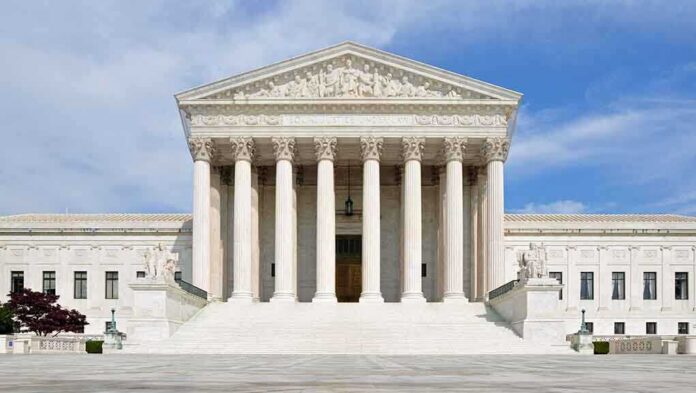
The Supreme Court cleared the way, at least for now, for President Trump’s mail-voting order to move forward, sharpening a national fight over who controls election rules and how ballots move through the mail.
Story Snapshot
- The Court paused a lower ruling that blocked parts of Trump’s order, keeping options open for limited implementation.
- The order directs new federal steps on mail ballots, including postal standards tied to citizenship lists and barcodes.
- Lower courts earlier said Trump likely exceeded his authority because states and Congress set election rules.
- The Postal Service signaled it could not apply new limits for the coming election absent further rules and court clarity.
What The Supreme Court Did And Did Not Decide
The Supreme Court issued an emergency order on August 24, 2026 that halted a lower-court block on parts of President Trump’s mail-voting order. The ruling did not decide the merits. It changed the legal posture so the administration had breathing room while appeals continued. The Court’s action followed a summer of fast-moving rulings that pulled the brakes, then released them, on pieces of the policy. The justices left open what the Constitution allows long term.
Earlier, a district judge in Boston found the president likely exceeded his authority and blocked key pieces nationwide. A federal appeals court refused to fully lift that injunction in late July. Those opinions leaned on a core point: the Constitution assigns election rules to states and Congress, not the White House. The Supreme Court’s late-August order did not reject that view. It only paused the remedy while the case proceeds.
What Trump’s Order Seeks To Change In Mail Voting
The March 31, 2026 order told the Department of Homeland Security to assemble citizenship-related lists, directed the United States Postal Service to write rules for uniform mail-ballot handling, and pressed the Attorney General to target unlawful ballot distribution. It also called for barcodes on ballot envelopes to track mail voting accuracy. The administration framed these moves as “safe, secure, and accurate.” Supporters argued federal standards would stop ineligible voting by mail.
The policy’s rollout depended on later agency rules, which slowed execution and invited court scrutiny. A federal judge said challenges were not ripe until the Postal Service finished rulemaking, which briefly helped the administration on timing. Later, another judge barred the Postal Service from carrying out parts of the order for the upcoming election, citing legal and practical limits. That push and pull left states, local clerks, and voters unsure what rules would actually apply on Election Day.
Why States’ Rights And Voter Access Are Colliding
Democratic-led states argued the president cannot set federal election procedures because the Elections Clause places that power with states and Congress. Courts echoed that concern, saying the White House cannot rewire mail-ballot delivery rules on its own. Voting-rights groups said the order risked blocking eligible voters, especially where database matching can mislabel citizens as noncitizens. They called the policy unlawful voter suppression.
EXCELSIOR!!! Supreme Court lets Trump proceed with mail-in voting order ahead of midterm elections https://t.co/WxS3FD76yS via @JustTheNews
— Ken Ward (@CcccurlyWard) August 25, 2026
The administration countered that uniform mail standards and tracking would deter fraud and boost confidence. But major news outlets reported that proven cases of mail-voting fraud are rare relative to total ballots, which weakens the policy’s factual footing in court and in public debate. The Postal Service also signaled that new limits could not be applied quickly without disrupting ballot delivery, stirring fresh doubts about feasibility this cycle.
What It Means For Both Sides Of The Aisle
For conservatives, the Court’s move looks like a short-term win for tighter mail-voting controls and clearer audit trails. For liberals, it looks like an overreach that risks wrongful rejections and new barriers for lawful voters. For everyone, the bigger issue is trust. People across the spectrum see a federal system that lurches between orders, injunctions, and partial stays, with little clarity for workers who must run elections on time.
Big government actors did not earn that trust. Agencies fought over scope. Courts split on power. Politicians fundraised off fear. Meanwhile, clerks, postal workers, and voters still need simple rules that work. The path forward runs through facts, not slogans: clear evidence of real risks, transparent error rates for any database checks, and safeguards to fix mistakes fast. The Supreme Court will likely have the last word. Until then, confusion carries a cost.
Sources:
aclum.org, reuters.com, npr.org, aclu.org, cnn.com, supremecourt.gov, apnews.com
© truetrendnews.com 2026. All rights reserved.