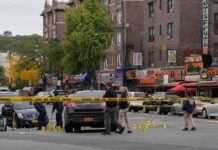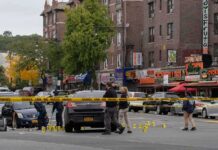

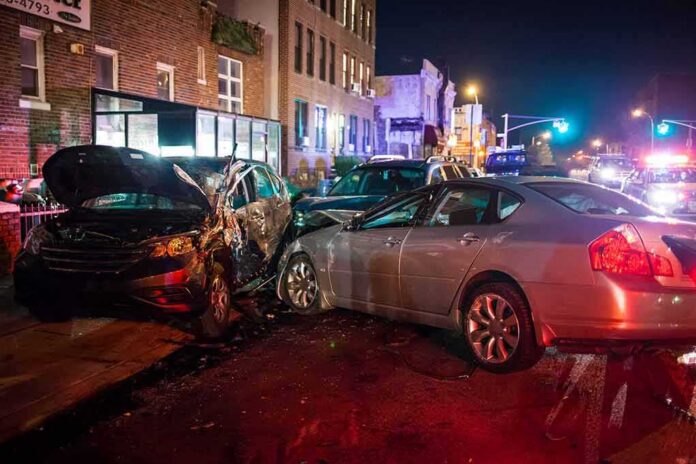
A Los Angeles jury convicted former nurse Nicole Linton of six counts of second-degree murder for blasting through a red light at about 130 miles per hour, a verdict that signals how far courts will go when driving crosses the line into a known threat to life.
Story Highlights
- Jury found Nicole Linton guilty of six counts of second-degree murder in the 2022 Windsor Hills crash.
- Prosecutors cited car data showing sustained acceleration to roughly 130 miles per hour with no braking.
- The defense said Linton had a seizure and lost control; a neurologist supported that claim.
- The verdict reflects California’s “implied malice” standard for deadly driving under People v. Watson.
What the Jury Decided and Why It Matters
Jurors in downtown Los Angeles found Nicole Linton guilty of six counts of second-degree murder for the Windsor Hills crash that killed six people, including an unborn child. Prosecutors argued that Linton knew the risk and drove anyway. They told jurors Linton ran a red light at extreme speed and made no move to avoid the crash. The verdict means the jury accepted that her driving showed a conscious disregard for life. Sentencing will follow under California law.
Prosecutors leaned on vehicle telemetry and video to make their case. They said Linton accelerated to about 122 miles per hour five seconds before impact and reached about 130 miles per hour when her car hit cross-traffic, with no braking or swerving shown in the data. In opening and closing, they argued she had time and space to slow down but chose not to do so. Jurors also saw graphic footage of the crash’s aftermath, which shaped the trial’s emotional tone.
The Defense’s Medical Emergency Argument
Linton’s defense said a sudden seizure caused a complete loss of control. Her lawyer told jurors she did not know a seizure was coming, and that a medical emergency is not murder. A neurologist testified that Linton likely suffered a seizure before the collision, pointing to signs consistent with a loss of consciousness. The defense also stressed there was no proof of alcohol use, drug use, racing, or phone distraction at the time.
Prosecutors pushed back on the seizure claim. They argued there was no medical proof of a seizure that day and pointed to the steady, high-speed acceleration as evidence of purposeful driving. In closing, the state said the patterns in speed and control did not match a driver blacking out, and that Linton had opportunities to stop. The jury’s decision suggests they found the telemetry and conduct more persuasive than the seizure theory. Still, the case shows how hard it is to weigh split-second health claims against hard data.
The Legal Frame: When Driving Becomes “Implied Malice” Murder
California courts allow second-degree murder charges when driving shows “implied malice.” That means the person knew their actions endangered life and did it anyway. The rule comes from the California Supreme Court’s People v. Watson decision, which opened the door to murder charges for deadly driving when facts show conscious disregard for life, not just negligence. Later decisions refined how juries should weigh intent versus risky driving behavior.
Nicole Linton — the former nurse who ran a red light at 130 mph through a Windsor Hills intersection was convicted of six counts of second-degree murder for the 2022 crash that killed six, including a pregnant woman; she faces 90 years to life. Story: https://t.co/7DNVDhcfvl
— CancelPeople.com (@cancelpeoplenow) October 3, 2026
The Linton verdict fits that pattern. Prosecutors did not need to prove a plan to kill. They needed to prove she knew the danger and still drove into it. Telemetry at extreme speeds and a red light can meet that bar if jurors believe the driver was conscious of the risk. Defense claims about a medical emergency can defeat implied malice if jurors accept that the driver truly lost control. Here, the jury decided the facts supported implied malice under Watson.
Why This Case Struck a Nerve Beyond Los Angeles
People across the political spectrum see a justice system that can be slow, uneven, and too focused on headlines. This verdict will fuel that debate. Some will say the state overreached by calling a crash “murder.” Others will say the law finally took reckless driving seriously. Both reactions link to a shared concern: public safety and fairness are not culture-war issues. They are basic duties of government that many feel have been ignored for too long.
What Comes Next: Sentencing and Policy Ripple Effects
Sentencing will determine how California now punishes the most extreme driving that stops short of premeditated killing. Lawmakers and district attorneys may cite this case as they set charging standards for future crashes involving extreme speed, red lights, or street racing. Defense lawyers will study how juries treat medical-emergency claims when telemetry suggests ongoing control. Expect more trials that turn on car data, expert witnesses, and whether conduct meets the Watson implied-malice line.
Sources:
latimes.com, mynewsla.com, newsbreak.com, foxla.com, nypost.com, oxygen.com, nbclosangeles.com
© truetrendnews.com 2026. All rights reserved.